High-Frequency Trading: An Efficient Trading Platform or a High-Speed Threat?
By Lidiane Cunha
In the age of Artificial intelligence, large investment institutions, hedge funds, and investors also use powerful computer algorithms to automate the transactions of many orders at extremely high speeds. Traders who employ this automated trading platform, called high frequency trading, can execute orders in the stock market in milliseconds or thousandths of a second—the average time it takes the human finger to click the mouse is allegedly 150,000 microseconds.
However, very little is known about how this automated form of trading affects capital markets and companies. While some researchers believe that high-frequency trading activities make the market more efficient, others warn us against their dangers. High-frequency trading is believed to increase investors’ losses and trigger major financial crashes. But that’s not all. When financial transactions are executed multiple times in fractions of a second, transparency and ethics can be at stake. Researchers and practitioners have long suspected that high-frequency traders may be acting opportunistically.
Since high-frequency traders buy and resell shares multiple times a day, they can artificially increase stock prices and profit largely when reselling shares. Their game however doesn’t benefit other players: by the time firms repurchase their own shares in the market, prices could be higher. As a result, these firms will be distributing less cash to their shareholders.
To better understand the impact high-frequency trading, Associate Professor Ali Akyol has been awarded a Telfer School of Management Research grant (SMRG). More specifically, he will examine if high-frequency traders artificially increase stock prices, and if firms who repurchase shares may be paying a high price at the end.
Who will benefit from this research?

“When a firm is buying back its shares in the market, an increase in the price means the firm needs to pay more for its shares. If high-frequency traders are found to be costing companies and their shareholders money, insights from this proposed study may contribute to the debate about regulations of high-frequency trading. Firms are required to follow strict rules when repurchasing shares, and from this perspective, this study will show if and how archaic rules and regulations affect these firms.”
Ali Akyol

Managing Conflicts in Family Businesses

“I was intrigued and decided to dig deeper to better understand how conflicts manifest in family businesses and how these firms deal with different types of conflicts.”
Hong’s research on the topic has led to her very first article, jointly published with her supervisor Full Professor Mark Freel in Family Business Review.
Family-related conflicts in family businesses
Family involvement in the family business can be a major source of conflict in these firms. Very often, these tensions intensify during the succession process, as family members tend to fight over the future control of the firm. The popular TV show Succession has shown that the conflicts can go terribly wrong for the business, the family, or both. Unfortunately, this doesn’t only happen in fiction.
Take for example the famous case of German brothers Adolf and Rudolf Dassler, who started a shoe business almost 100 years ago. Unable to deal with their personal differences and tensions, the two brothers went separate ways in the 1940s. Adolf founded Adidas and his brother founded Puma. Their rivalry persisted over 70 years and even divided the small town where their factories were built—on opposite sides of the river. The Dassler brothers never reconciled.
But not all family business conflicts end this dramatically. The UK-based Clarks shoe firm is a great example of how family firms can successfully manage conflicts and survive for multiple generations. When Asian shoe companies flooded the market with affordable products in the 1990s, the Clarks faced a major crisis that divided them between those who wanted to sell out and those who didn’t. In the end, they decided to keep the business firmly in the hands of the family while hiring a non-family executive team to run the firm. The company managed to stifle internal conflicts, improve communications, make better decisions, and increase their profits.
The most common conflicts experienced by family businesses
Hong’s review of over 90 studies on the subject shows that the most common conflicts facing family businesses are the following:
- Conflict of interest – Firm founder/owner, managers, and shareholders may disagree and start a conflict when their interests and priorities are not the same.
- Work-family conflict – When you work in the family business, your role as parent, child, or in-law, and your position in the company as owner, manager or employee inevitably overlap. it can be challenging to disentangle family life from business when two family members are caught in a conflict, personal or otherwise.
- Relationship conflict – Family members are emotionally attached to one another. When they don’t agree with a family member’s intentions or actions, this incompatibility can trigger negative emotions such as hostility, annoyance, and frustration.
Conflict management strategies: pros and cons
Every conflict management strategy has pros and cons and its effectiveness often depends on the context:
- Avoiding conflicts, a strategy that is often considered negative, can actually help family members cool down their negative emotions before they are ready to address the issue.
- Collaboration is often perceived as a win-win strategy, but it requires significant time effort, commitment, and interpersonal skills. This may not be the best choice if the family firm needs to act immediately in the face of a conflict or if the family lacks a supportive organizational culture.
Academic contribution
Researchers have often drawn on practical insights to address how families manage family-related conflicts in the business. Hong explains that this approach can offer snapshots of conflicts, but not necessarily the bigger picture:
“The long-term orientation of family businesses forces researchers to adopt a more comprehensive approach in their studies of family-related conflicts. This can help us better understand the root causes of intertwined conflicts and how to use specific strategy to achieve desired outcomes.”
A parent-child conflict might result in the dismissal of the competent child who was chosen to lead the business. This can encourage other managers to leave, and the company might underperform. When analyzing the process over time, researchers may discover that it was poor firm performance that triggered the parent-child rift in the first place.
Understanding that what motivates a conflict in family firms, how the families deal with it, and the outcomes of their choices is not that simple, Hong chose to advance our knowledge about family conflicts through a conflict management lens. Very few scholars have attempted to look at various types of conflicts and conflict management strategies and how one influences the other.
Practical advice for practitioners and family business leaders
If you are a family business practitioners or work in a family-owned firm:
- Look at the pros and cons of conflict management strategies the authors identified in the paper (Table 3).
- Select the appropriate conflict management strategy that can help you reduce potential damages;
- Don’t simply choose one strategy over the other when dealing with conflicts in the family firms: try out multiple strategies.
- Adapt your strategies over time and according to the changing conditions of the family firm you are working with.
Read the full article: Qiu, Hong and Mark Freel. “Managing Family-Related Conflicts in Family Businesses: A Review and Research Agenda.” Family Business Review.
By Lidiane Cunha

The importance of social connections in fostering meaningful work
By Lidiane Cunha
Is your work meaningful to you? In a new article published in the Academy of Management Review, Associate Professor Jane O’Reilly, from the University of Ottawa’s Telfer School of Management, and her co-authors claim that employees develop a sense of meaning when they can achieve goals that have a purpose. However, to achieve these goals, employees need to have social connections to others who can offer them supporting resources along the way.
For many of us, it may not be only about what we do, but rather who can help us achieve what we do that ultimately cultivates meaningful work. Watch the video to find out why employees, organizations, and managers should be aware of the importance of social connections in fostering meaningful work:
Animation designed by Lisa Chhun
Voiceover by Nina Nesdoly
Read the article published by Professor O’Reilly and co-authors:
Robertson, K., O'Reilly, J. and Hannah, D. 2019. “Finding Meaning in Relationships: The Impact of Network Ties and Structure on the Meaningfulness of Work.” Academy of Management Review.
Learn more about the research happening at the Telfer School of Management that seeks to improve employee well-being: Thriving Organizations and Societies

Jane O'Reilly is an Associate Professor and Telfer Fellow in Workplace Wellbeing at the Telfer School of Management. Her research examines informal workplace interactions and relationships. Learn more about her work.

Breaking Burnout: Improving Employee Mental Health and Well-Being
In the current fast-paced and ever-connected reality of work, many of us feel overwhelmed by tight deadlines, inflexible work schedules, and high expectations to meet our targets and stay productive. But is the current workplace environment actually increasing our productivity?
A recent study suggests that 9 out of 10 Canadian employees feel burned out at work. Burnout is a syndrome resulting from chronic work-stress that hasn’t been properly managed. Now more than ever it is important for organizations and managers to find creative ways to promote mental health and well-being and help their employees manage their stress levels.
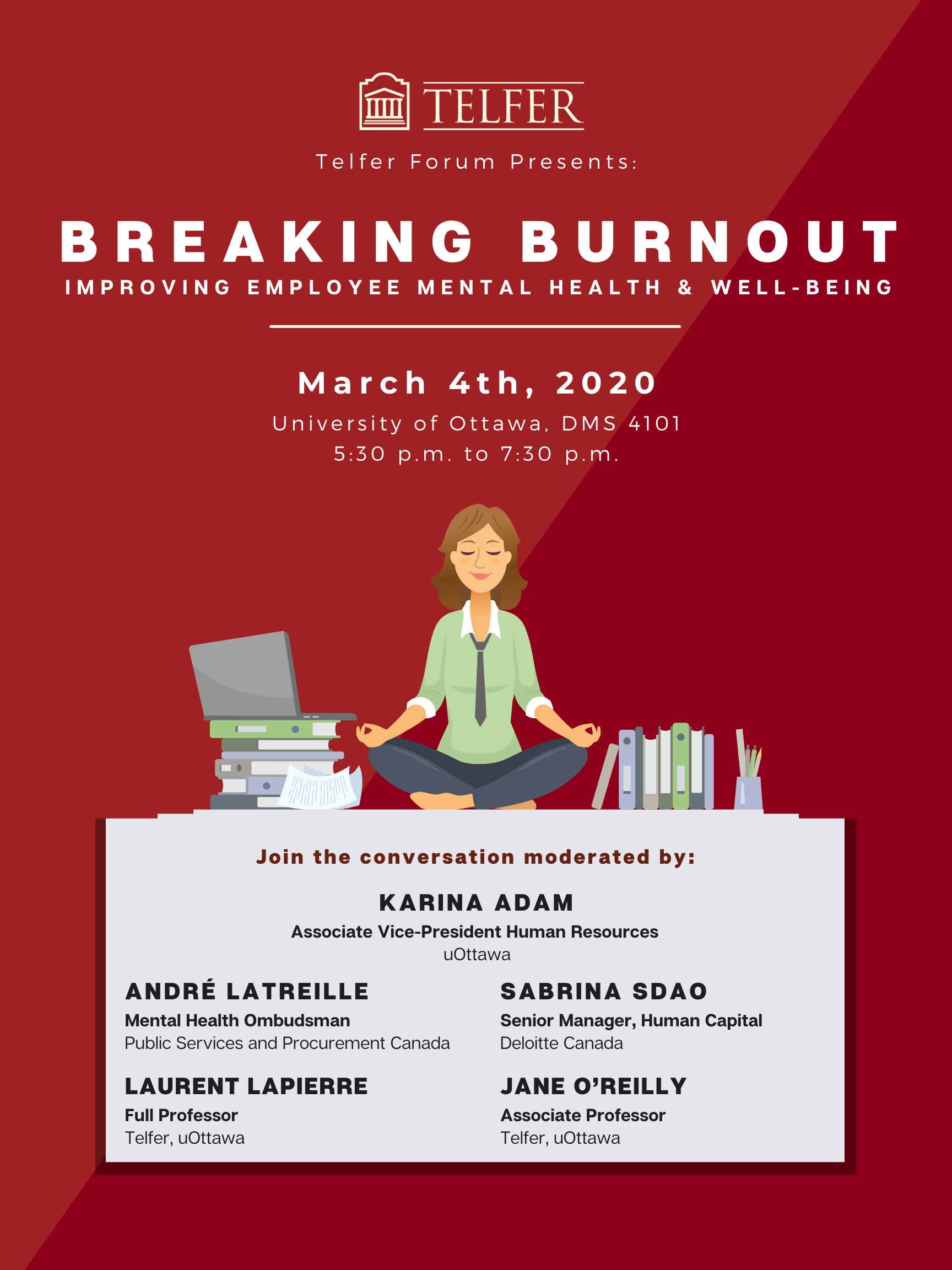
Join us on March 4th, 2020 in our next Telfer Forum, Breaking Burnout: Improving Employee Mental Health and Well-Being. A panel of experts from uOttawa, Public Services and Procurement Canada, and Deloitte Canada will share the latest evidence-based insights and best practices to tackle the following questions:
- How can managers identify burnout and what are the biggest “culprits” that lead to burnout?
- What factors promote and maintain employee well-being?
- How can leaders implement solutions to promote employee mental health and wellbeing? What are the challenges?
This free event will be a great opportunity for researchers, leaders, and HR professionals seeking to better understand how organizations can foster a healthier workplace environment.
This presentation will be in English only. Light hors d’oeuvres will be served.
Date: March 4, 2020
Time: 5:30 p.m. to 7:30 p.m.
Location: Telfer School of Management, University of Ottawa, room DMS4101, 55 Laurier Avenue East, Ottawa.
The Telfer researchers involved in this forum are part of Thriving Organizations and Societies (“Thriving Org”), a new Area of Strategic Impact recently launched at the Telfer School of Management.
.jpg?x=0&y=1&x2=765&y2=511)
The Role of Leadership in Building More Sustainable Cities
By Lidiane Cunha
The construction and development industry is a large contributor to the Canadian economy, employing over 1 million people and accounting for 6% of national GDP. Unfortunately, it is also one of the worst environmental offenders, consuming over 50% of all raw materials extracted, producing 30% of solid waste disposal, and contributing approximately 40% of global CO2 emissions. Despite the growing and urgent need for more socially and environmentally sustainable urban developments, the construction and development sector has been one of the slowest industries to adapt to more sustainable practices.
How can this industry build more urban neighborhoods that respect the environment and contribute to the social and economic development of local communities? The answer might lie in the hard work of leadership. A recent study co-authored by Associate Professor Daina Mazutis suggests that leadership plays a major role in driving forth sustainable urban transformations. In the article published in the Journal of Cleaner Production, the authors analyzed the case of the Zibi Development. The development is a One Planet Living community currently under construction in Canada’s capital region. We interviewed Professor Mazutis to find out about the role of leadership in bringing radical change to the sector.
What are the main barriers impeding construction companies from achieving more sustainable outcomes in the construction sector?
The construction and development industry, like many others, is characterized by competitive dynamics that create small margins and therefore extreme cost pressures. Unfortunately, there is a misconception that sustainability is expensive, when in fact, more sustainable designs result in much lower building operating costs over time.
Tell us why you chose to analyze the Zibi Development in your study.
When we moved back to Ottawa in 2015, I was introduced to Jonathan Westeinde, Founder and CEO of Windmill Development Group through a mutual friend, and he agreed to guest lecture in class on Business in Society, where he told the Zibi story. Given that I research leadership and sustainability, I was hooked! Here was someone trying to build one of the world’s most sustainable communities right in our backyard! We kept in touch and the following year and the next, I took some of my students to tour the Zibi site with Jonathan. This experience led us to write a case, which has been taught in some of my classes. Ever since, I have been following their progress with great interest and so we decided to dive deeper and examine the work of the leadership team responsible for the Zibi project. We wanted to bring wider attention to what they were doing.
What were the main challenges faced by the leadership team at Windmill Developments in the Zibi Development? How did they address these challenges?
As a research site, the Zibi development is particularly interesting due the enormity of the challenges Windmill development faced, beginning with acquiring the right to develop the property through to implementing their vision. The land in question is an abandoned industrial wasteland that lies partially in Quebec, partially in Ontario and has portions monitored by the National Capital Commission (a federal agency). The land is also considered unceded Algoniquin territory. The political and cultural minefield is unparalleled and yet Windmill was successful in navigating this complexity, securing broad based buy-in for their One Planet Living design. They are currently in the thick of construction.
Your study focuses on how sustainability leaders play a pivotal role in promoting change in the construction sector. Can you identify the 5 critical tasks leaders need to take on to instill sustainable innovation in the sector and deliver more sustainable urban developments?
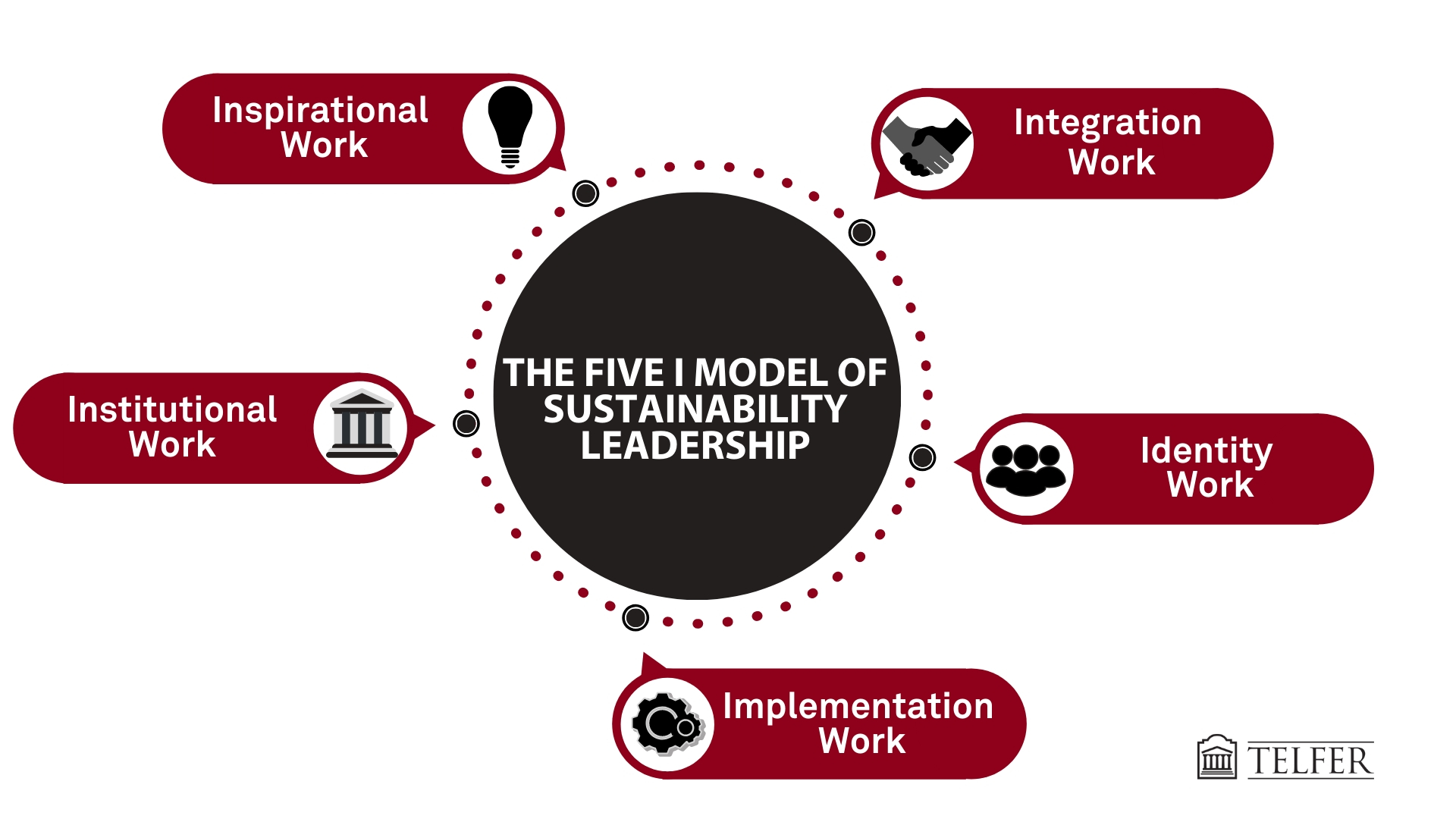
Here is what we found that sustainability leaders do drive more sustainable urban transformations. We call it the 5I Model of Sustainability Leadership:
- Inspirational Work: Sustainability leaders are able to rethink traditional approaches to construction and development by learning from international best practices and partnering with outside experts to create a compelling vision for the community.
- Integration Work: In order to negotiate complex multi-partner agreements, sustainability leaders engage stakeholders in a collaborative decision-making process and look for general principles that everyone can agree on.
- Identity Work: The most difficult task for sustainability leaders is to manage dissenting perspectives so all involved can retain their individual identities while building a new collective identity. This requires open, transparent and frequent communications and partnering to develop inclusive joint projects.
- Implementation Work: This is the nuts and bolts of designing and building a sustainable community. Sustainability leaders can implement the bold objectives set by hiring the right people with the right skills and without compromising on the original principles.
- Institutional Work: Sustainability leaders work hard to maintain commitment to the vision by embedding sustainability into every aspect of the project and re-confirming alignment at regular intervals. If they fail to do so, the competitive pressures in the industry can easily derail more sustainable outcomes.
What’s the takeaway of your study for sustainability leaders in the sector?
Designing and developing sustainable communities may be difficult, but ultimately, the rewards far outweigh the challenges. The Zibi Development has won many international awards that have led to more contracts and more sustainable construction and development projects. Positive changes are possible, even in the most traditional industrial sectors!

Daina Mazutis is an Associate Professor of Strategy at the University of Ottawa where she also holds the Endowed Professorship in Ethics, Responsibility and Sustainability. Her research focuses on leadership, strategy and sustainability. Learn more about her work.