Major Challenges Faced by New Firms in Transitional Countries
Meet our New Faculty
Hien Thu Tran has recently joined the Telfer School of Management as an Associate Professor. We interviewed Professor Tran to learn more about her research on innovation and entrepreneurship, particularly in the context of transitional countries.
What are your research interests?
My research is truly interdisciplinary, as I have conducted research on the topics of innovation, entrepreneurship, management, and industrial economics. I am mostly interested at studying the factors that lead businesses to survive, innovate, and prosper.
In your article titled “Institutional quality and market selection in the transition to market economy,” recently published in the prestigious Journal of Business Venturing, you look at how some external factors shape firms in transitional countries. Why transitional countries?
These countries are in transition from a centrally-planned to a market economic system. While undergoing this transitional process, they tend to open up their market and promote international businesses and trade with other countries. Most of these transitional countries are developing into emerging markets. Because transition countries have been under-studied, they offer a distinctive and useful context for extending our knowledge beyond what was already known about developed countries.
On a personal level, I chose to study transitional countries because I originally come from Vietnam, which started the transitional process in the late 1980s but only entered the group of emerging markets in the early 2000s.
What happens to young firms in transitional countries?
I observed a common trend: young firms that are dynamic, innovative and productive and whose owners are highly educated are more likely to fail in transitional countries than similar firms in developed economies.
In an open-market society, the survival of fittest applies in developed countries, but not in transitional economies where other factors may become obstacles to even the fittest of these new firms. These firms perform better and are more innovative than companies that have been in the market for a while.
Why do these new firms tend to fail in this context?
In my study I looked at several factors that contributed to the early failure of these new firms. There are institutional forces that prevent transitional countries from embracing a liberal market system, making the environment difficult for these new firms to grow and develop. This may be happening because the institution can negatively impact new firms’ ability to prosper.
What challenges do these young firms face?
Looking at how the institution may lead high performing and innovative young firms to exit the market, I was able to identify a list of indicators that impact the chances for these firms to succeed or fail.
For example, if the country’s administrative system is corrupt, inefficient, or not transparent, there is a high chance that these companies will fail in comparison to more established state-owned and private firms. The entry cost for new businesses, policy bias, labor training, and regulations also play an important role in promoting or inhibiting fair competition between new and already established firms.
What’s your advice for policy-makers?
In order for these new firms to survive and remain productive, policy-makers need to improve transparency and efficiency in the country’s administrative and legal systems. They should also ensure that these systems are applied equally to all firms.
Research Annual Report 2017-2018: Impactful and cutting-edge research
In the academic year of 2017–18, faculty members and graduate students of the Telfer School of Management demonstrated how well equipped they are to produce impactful and cutting-edge research that addresses relevant societal problems.
Towards A More Effective Way to Manage IT Projects
The challenges of IT Project Management
Despite decades of research dedicated to better understanding IT project management and identifying more effective ways to manage IT projects, many of these organizational systems still fail today.
Take for example the case of project Phoenix, a payroll processing system for Canadian federal government employees. “According to observers, the famous Phoenix Project failure can be attributed to problems related to project management and the implementation process rather than simply to technical issues,” explains Muriel Mignerat, an Associate Professor at the Telfer School of Management at the University of Ottawa.
Studies in the field of project management have shown that project managers often face challenges navigating the competing demands of projects.
What’s the research about?
To better understand the nature of competing demands that IT project managers face, professors Muriel Mignerat (Telfer School of Management) and Suzanne Rivard (HEC Montréal) have launched a research project entitled “Vers une gestion efficace des exigences contradictoires dans les projets de technologies de l'information”. The two researchers have received a prestigious Insight grant from the Social Sciences and Humanities Research Council (SSHRC).
“Our goals are to identify the competing demands that often exist in IT project management and understand how and if these problems can be resolved. We will also examine if these resolutions may actually lead to successful IT projects,” says Professor Mignerat, the lead researcher.
By doing so, Professor Mignerat and her research collaborator hope to:
prepare an overview of the challenges at every stage and every level of IT project management; and
propose concrete actions that IT project managers can take to resolve seemingly problematic situations, by highlighting their positive potential.
Who gains?
The results will help advance knowledge in the field of project management and propose concrete solutions for practitioners. Ultimately, the research insights can help managers improve the efficiency and effectiveness of IT projects. The researchers will share their insights with the non-academic community through:
The Telfer School of Management is committed to developing cutting-edge research in a variety of topics in management. As our faculty continues fostering research excellence, the Telfer School community and partners also benefit from valuable insights with impact. Over the next weeks, we will give an overview of the eight research projects that received the prestigious SSHRC Insight Grant in 2018. Click here to learn more about how to apply for a SSHRC Insight Grant.
Can An Independent Board Discourage Insider Trading?
Positive and negative outcomes of private in-house meetings
Private in-house meetings in corporate headquarters have long served as a valuable communication channel between firm executives and key external stakeholders (investors and analysists). During these meetings, both parties can learn a lot from the interactions that take place without violating the law. Such meetings can improve communication transparency and ensure that information flows symmetrically between the executive team and investors/analysts.
However, a study co-authored by Professor Shantanu Duttahas suggested that the content shared during these meetings could also open the door to opportunistic insider trading activities. If private in-house meetings can be a valuable information exchange tool for executives and external stakeholders, how can private organizations promote information symmetry while discouraging insider trading?
The researchers will look at how private organizations can promote the positive outcomes of private in-house meetings and mitigate opportunist insider trading. “We suspect that one key strategy is that organizations can work with an independent board who could oversee these private meetings,” explains Professor Dutta, the lead researcher on this project.
Professor Dutta and his collaborators will evaluate if establishing an independent board:
promotes more interaction between the executive team and key investors to reduce information asymmetry,
is likely to discourage executives from sharing price-sensitive information with external stakeholders during private meetings.
Who gains?
The results of this research will have practical significance for regulators and policymakers who are concerned about potential unintended consequences of private in-house meetings.
“Unfortunately, there is little evidence that fair disclosure regulations are effective. Controlling opportunistic insider trading is also challenging. We will examine if and how an independent board may be able to make firm-specific trade-offs in ways that broad federal regulations cannot,” says Professor Dutta.
The Telfer School of Management is committed to developing cutting-edge research in a variety of topics in management. As our faculty continues fostering research excellence, the Telfer School community and partners also benefit from valuable insights with impact. Over the next weeks, we will give an overview of the eight research projects that received the prestigious SSHRC Insight Grant in 2018. Click here to learn more about how to apply for a SSHRC Insight Grant.
How different families shape family businesses
Families are not all the same
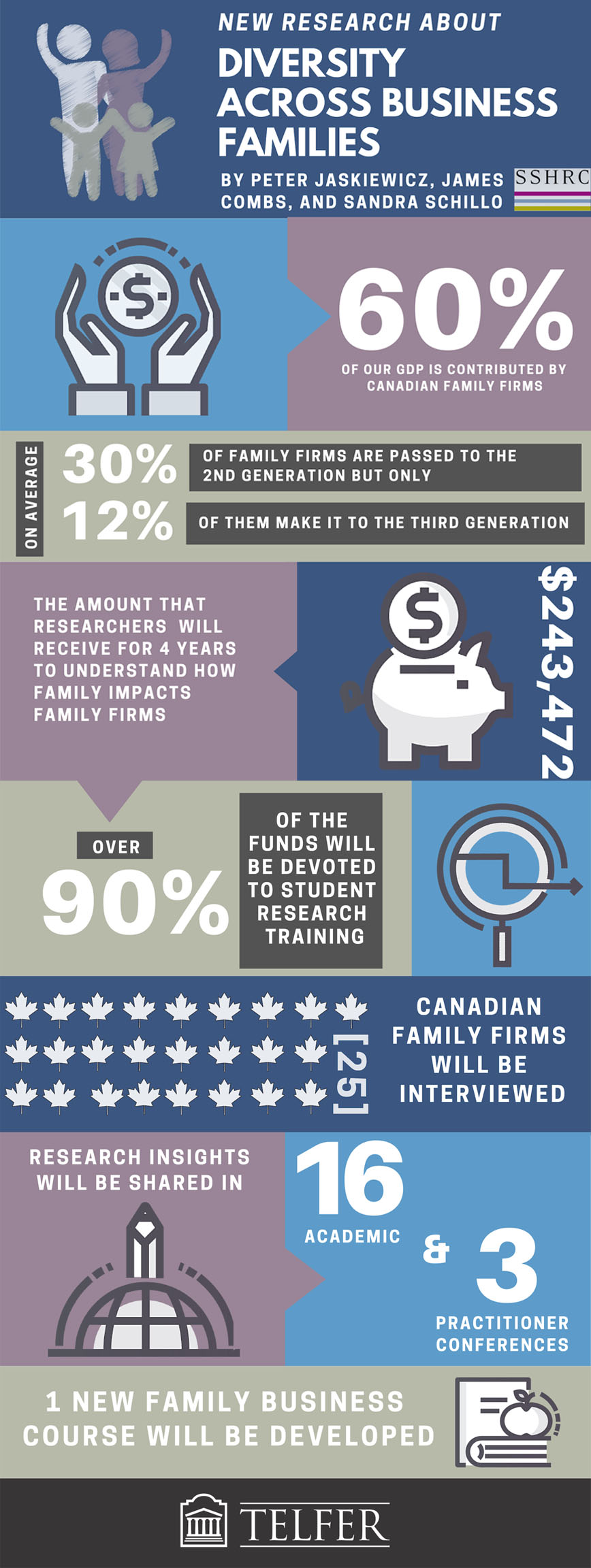
Family businesses are the backbone of all economies – including Canada’s, but are they all the same? How families are organized, what they care about, and how they pursue their unique goals are changing rapidly. Contemporary families are more diverse than ever before. For example, families have become smaller and more geographically disperse. They do not always represent the "traditional" married couple with two children living in the same household.
“Practitioners and scholars have recognized that differences among family firms are driven by the families behind the firms, but do all these families experience their business in the same way? We know very little about when, why, and how non-traditional family structures manage, succeed, or fail in their family businesses,” explains Professor Peter Jaskiewicz.
By understanding key family differences and how they shape family firms, the researchers can provide valuable insights for:
practitioners who advise and work with business families
grounding public policy
Ultimately, the team hopes their findings will strengthen entrepreneurship, performance, and longevity of family firms, which are critical for a healthy economy and continued Canadian prosperity.
“Our research program has a great potential to generate knowledge to support practitioners in their efforts to manage the family-firm relationship and help policymakers to reevaluate how family transitions and broader social changes can be dealt with in ways that do not threaten 60% of the firms in the economy,” adds Professor Jaskiewicz.
To support Canadian family businesses/ business families in Ottawa, the researchers will:
organize a workshop with practitioner and policy-makers
deliver a list of policy recommendations to the Federal Minister of Innovation, Science and Economic Development and the Federal Minister of Small Business and Export Promotion.
The Telfer School of Management is committed to developing cutting-edge research in a variety of topics in management. As our faculty continues fostering research excellence, the Telfer School community and partners also benefit from valuable insights with impact. Over the next weeks, we will give an overview of the eight research projects that received the prestigious SSHRC Insight Grant in 2018. Click here to learn more about how to apply for a SSHRC Insight Grant.




.jpg?x=0&y=125&x2=386&y2=382)