
Laws of attraction: We respond more favourably to altruistic leadership
Acclaim for altruistic leaders abounds. A 2015 survey of millennials by Deloitte found that 75 percent of millennials believe businesses are too fixed on their agendas and not focused enough on helping to improve society. There’s increasing attraction to Corporate Social Responsibility (CSR) deemed genuine, says Magda Donia, an assistant professor at the Telfer School of Management. The trend underscores, from an organizational behaviour perspective, that “motives matter” (real and attributed), professor Donia explained in an interview.
So, when is Corporate Social Responsibility (CSR) a hit with employees?
My research and other scholarship shows that employees’ attributions in regard to their employer’s CSR efforts – in particular whether they view them as symbolic or substantive – matter a lot. Patagonia involved their employees in relief efforts after BP’s Gulf of Mexico oil spill. They provided full financial support and salary and related expenses to empower their employees to contribute fully to the relief efforts. These kinds of organizations choosing substantive CSR tend to be viewed more favourably by employees and they will likely appeal to millennials in the job market too.
What about symbolic CSR? Is it better than doing “nothing at all”?
Maybe. Then again, it might not be worth doing. If the employees evaluate their organization’s CSR efforts as self-serving, there will be costs. There will be cynicism and charges of green-washing.
Where do the employees come up with their “attributions”?
These are attributions shaped by a wide range of influences and, in particular, a person’s work experiences. Think of the employee as an intuitive psychologist who observes their employer’s CSR behaviour, then imputes certain motives. Because this sensemaking of observed behaviors is often more automatic than conscious, it is powerful. Managers should take note. As should, for that matter, anyone in the company with a say in creating and communicating CSR programs.
Your research also says leadership that looks out for the needs of others benefits organizations.
Yes, there is evidence of what we call servant leadership helping employee wellbeing. Where you have a more altruistic leader, you tend to have more job satisfaction and less chance of turnover. Our research using data collected from 192 supervisor-subordinate pairs found that this relationship holds true for employees with selfless and those with self-serving motives. Although as expected, subordinates’ motives influence the strength of the connection. The employees who were high on impression management reported lower levels of job satisfaction than those that were not.
What are the implications of all this for CSR and altruistic leaders?
A leader may be great, but if the employee’s motivations are not aligned with those of the leader, there is a limit to the value this leader can provide. It would appear that for a follower to accept a leader’s influence and benefit from his or her leadership style, that leader must incorporate at least some of the employee’s vision of an ideal leader.
As for corporate social responsibility, we have data showing that employees’ attributions of CSR as symbolic are not related to valued attitudinal and behavioral outcomes like commitment to the organization. Such attributions may even lead to negative outcomes and feeling that one’s values do not match those of the firm. The bottom line is that in order for employees to respond favourably to their employer’s efforts, they have to attribute these efforts as substantive.
- For more information: Donia, M.B.L. & Sirsly, C-A. Tetrault. (2016). Determinants and consequences of employee attributions of corporate social responsibility as substantive or symbolic. European Management Journal; Donia, M.B.L., Raja, U., Panaccio, A., & Wang, Z. (2016).Servant leadership and employee outcomes: the moderating role of subordinates’ motives.European Journal of Work and Organizational Psychology.

Innovate Health, Not Healthcare: The Mayo Clinic Way
.jpg)
Over sixty professors, health professionals, business leaders, civil servants and students gathered at the Telfer School of Management on March 30 to listen to Dr. Douglas Wood talk about “innovating health, not healthcare” during a seminar organised by the Telfer Health Transformation Exchange (THTex). The purpose of THTex seminars is to “bring together business academics from [The Telfer] school and from others schools, and physicians who are interested in innovating health,” notes Professor Wojtek Michalowski, co-director of the THTex.
During his presentation, Dr. Wood, Medical Director for the Center for Innovation at the Mayo Clinic, explained to the audience how the way they think and work, and their work process, which is very different from other sectors, sustains innovation. For him, innovation is discovering and implementing ways to deliver better health.
The Mayo Clinic Center for Innovation’s experience in transforming how people achieve health offers new insights for delivery system innovation that will help patients and health care professionals. They have a fresh approach on different aspects of health services. More importantly, they concentrate on health professionals and patient experience by thinking about solutions first.
The main key to their processes, led by designers, is to focus on what people in the community need in terms of health delivery services. ‘‘The real measure of successful design is how well it works (…) and that is what we need in healthcare, that it work and that we work together”.
Dr. Wood gave the audience examples of the Mayo Clinic Center for Innovation’s successful projects while explaining their approach and how their designers worked to achieve the ‘‘innovation, the integration and navigation of their health processes’’.
After the presentation, the audience engaged discussions relating to healthcare transformation, new technology and integration of processes to the workplace culture.
A special thank you goes to Kathy Cunningham, Wojtek Michalowski and Michael Fung Kee Fung for preparing this seminar. This was a very successful event for the THTex. The next seminar will be held on May 18, 2016, when the THTex will welcome Dr. Eric Isselbacher, Director of the Healthcare Transformation Lab at Massachusetts General in Boston. He will be speaking on transformation and innovation, using experiences from Mass General. We look forward to this upcoming event.

Building better health information systems
Increasing complexity and costs put the health system on an uncertain trajectory. In a context of workforce pressures and increased need for services, where will the next advances in care delivery come from? One answer is health information technology (HIT), long expected to be a key driver of improvements in patient care delivery and healthcare transformation.
But behind this optimistic view of technology lies a troubling reality: stories of negative outcomes from HIT implementation are legion. The Telfer School’s Craig Kuziemsky says communication issues, creation of new or more work, and even adverse events such as medical errors are so habitual at the implementation stage that some are left to wonder if HIT will ever deliver on its promise.
Fulfilling technology’s potential
While interoperability is the underlying basis of integrated healthcare delivery, most of the work to date has not dealt with the interoperability of the people and processes that engage with HIT. To address this gap, healthcare decision makers will need to pay a lot more attention to the business processes that underpin HIT, argue Professor Kuziemsky and his colleague Professor Liam Peyton of the School of Electrical Engineering and Computer Science.
The team developed a framework based on their two-year case study of a palliative care information system (PALS-IS) in Ottawa. They identified three categories of process interoperability issues that arose during system implementation: care delivery, clinical practice and administrative. The researchers also found that many of these issues emerged over time, and that developing solutions to some process interoperability issues subsequently led to other problems.
Taking a wider lens on interoperability
A significant challenge was when process automation crosses user groups, like clinicians and administrators. Administrators, for example, were under increasing pressure to provide accountability and performance management data. Meeting those needs often increased the workload of front-line clinicians who had to collect the necessary data to support administrative process interoperability.
These conflicting results demonstrate that HIT really is a disruptive technology. But, as Kuziemsky says, “our ability to be successful at implementing HIT will be defined by how well we manage the disruptions.” And despite trials in putting HIT into operation, “all our stakeholder groups saw great potential in how it could enhance clinical processes like patient management, or administrative processes like monitoring and reporting.”
An interaction of technology, processes and people
These findings provide the first tangible framework focused solely on process interoperability, and offer HIT designers and vendors practical guidance on how to evaluate this aspect. “My advice to people or organizations implementing HIT would be to take these findings seriously,” says Kuziemsky. “Most healthcare IT models have had very little to say about process interoperability, as interoperability is more typically considered from a technical or a semantic point of view.
“But if HIT is really going to be a driver of healthcare transformation, we will need to design systems with a lot more sensitivity to the overall healthcare ecosystem where technology, processes and people interact.
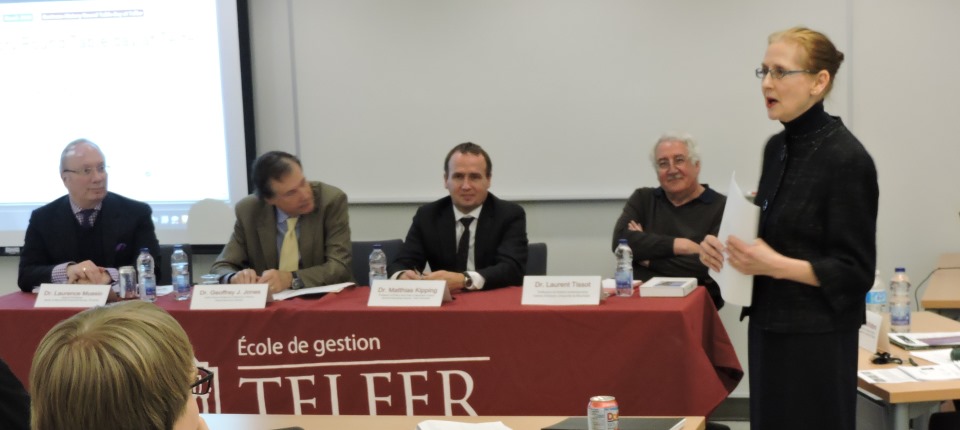
A First-Ever "Business History Day" at Telfer
Scholars explored “why history matters” in the context of business studies on March 4, drawing an audience of 50 to Telfer, including professors, students, entrepreneurs, and civil servants.
“History offers abundant lessons for future business leaders,” noted Professor Cheryl S. McWatters, the organizer of ‘Business History Day’ at Telfer. “Clear parallels can be found between past and present, in the challenges that confronted business people of bygone eras, and in the complex systems they developed to respond to those challenges.”
McWatters, the Father Edgar Thivierge Chair in Business History, chaired a panel discussion focusing on developments in business history research and teaching and panellist Laurence B. Mussio captured a recurring theme in the discussion when he stated that students, when given the opportunity to engage with history, invariably discover “an important and sophisticated tool” to understand business. “People are responding to this call because they know instinctively that in business decision-making, understanding the economic, social, political and cultural context of the day matters.”
The event’s keynote speaker, Professor Geoffrey G. Jones of Harvard Business School, examined the history of green entrepreneurship in a global setting. While working and often struggling at the margins of mainstream business, Dr. Jones noted, green entrepreneurs in the past nonetheless demonstrated “an impressive record of early identification of issues, radical rethinking of accepted wisdom, and a stubborn search for solutions and innovations.”
The Thivierge Chair in collaboration with the Accounting History Review and the Canadian Enterprise History Network/Réseau canadien d’histoire brought the following distinguished scholars together:
- Geoffrey G. Jones, Isidor Straus Professor of Business History at Harvard Business School and Faculty Chair of the School’s Business History Initiative
- Matthias Kipping, Professor of Policy and Chair in Business History, Schulich School of Business, York University
- Laurent Tissot, professeur en histoire contemporaine, Institut d’histoire, Université de Neuchâtel
- Laurence B. Mussio, Historian, Bank of Montreal Financial Group, Toronto, and Adjunct professor, Department of Communication Studies and Multimedia, McMaster University and Syracuse University.

Daina Mazutis explores the relationship between strategic leadership and sustainability
Daina Mazutis is the new Endowed Professor of Ethics, Responsibility and Sustainability (ERS) at Telfer, focusing her research on the path to more socially and environmentally conscious organizations. With studies that lie at the intersection of strategy, leadership and corporate responsibility, Mazutis is interested in understanding better the barriers and enablers to successful adoption of sustainable practices.
“Heightened public expectations for corporate citizenship have led, at one end of the spectrum, to “greenwashing”-type initiatives meant to deflect attention away from inaction or worse, misconduct, and at the other end, substantive efforts to match ‘doing good’ with ‘doing well,’” says Mazutis, who teaches a course on the Social Issues of Business. “To achieve more of the latter, we will need our students and future business leaders to approach environmental and social issues facing organizations today as critical strategic issues that require a broader understanding of business’s role in society.”
In addition to her academic background (Ph.D. from Western University and most recently a professor of strategy at IMD, Lausanne, Switzerland), Mazutis brings extensive industry and leadership experience to the task. Daina spent over 10 years in advertising, marketing, consulting and sales where she specialized in the strategic planning, research, development and implementation of national marketing campaigns for large multi-national clients. Direct involvement with a variety of strategic initiatives awakened an interest in understanding the important role of “leaders who are more likely to be engaged in sustainability business practices and ethical behaviour…the leaders who are willing to go above and beyond required practices.”
The ability to abolish unsustainable practices within a firm no doubt also turns on company culture and its employees. Employees, for their part, not only fulfill the aspirations of leaders, they can move calls for even more sustainable practices up the management chain. Customers also have, with social media, a much bigger platform to demand change than they had previously. “But finding a match between leadership character and strategy is probably the biggest factor in whether a firm becomes an exemplary leader or a disappointing laggard,” Mazutis says.
“If we want companies to break away from the pack in terms of sustainability, we have to understand the role of leadership and strategy but also these other change agents. How companies get to a better place in terms of sustainability, who or what leads them there, and what become the key motivating factors for firms to transform are all centrally important questions in my research.”
Recent publication: Daina Mazutis and coauthor Christopher Zintel published “Leadership and corporate responsibility: a review of the empirical evidence” in Annals of Social Responsibility. The paper was also presented at this year’s Academy of Management conference in Vancouver (August 2015) and appeared in abstract form in the best paper proceedings.