
Do I Deserve the Business and/or Wealth I Will Inherit? – Excerpt from Enabling Next Generation Legacies
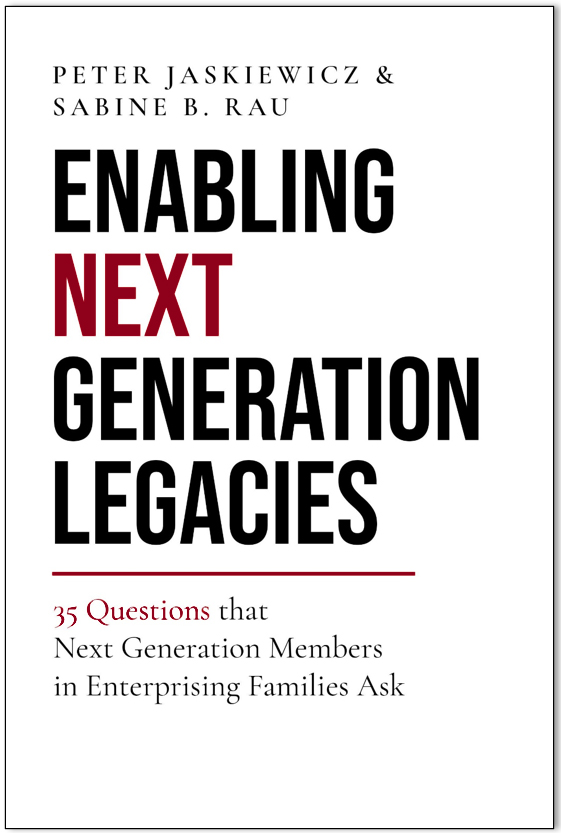
In coordination with the Family Enterprise Legacy Institute (FELI), the Telfer Knowledge Hub has been featuring select excerpts from the book, Enabling Next Generation Legacies: 35 Questions That Next Generation Members in Enterprising Families Ask.
The result of years of international research and practical experience, Enabling Next Generation Legacies delves into the unique challenges that confront family enterprises.
Telfer professors Peter Jaskiewicz and Sabine Rau have brought together the world’s leading academics, practitioners, and enterprising families to answer the most pressing questions faced by Next Generation members in a short and concise, yet meaningful way.
The book consists of best practices, real-life examples, and additional critical questions for reflection from nearly 100 contributors from 27 different countries. Expert commentaries come from members of the world’s leading family businesses including Auchan (France), Saputo (Canada), and Sabra (Israel), as well as from various academic experts from business schools around the globe like Kellogg, IMD, and INSEAD.
Below, read an expert response to a pressing question raised by Next Generation members.
Do I Deserve the Business and/or Wealth I Will Inherit?
Response by Nava Michael-Tsabari, Israel
Like Hamlet's contemplation reflecting his own self-doubt ("to be or not to be"), this is the question most Next Gens of a family firm ask themselves. Wealth is defined as the total assets owned by a family at one time[i], yet family firms have emotional value as well.[ii] Even medium-sized family firms (businesses that generate about $13 million in revenues with some thirty employees) may create wealth which categorizes them among the wealthiest class in society[iii]. However, Next Gens have mixed feelings about succession of firm and wealth, and when asked about it, their feelings of obligation are twice as high as their own desire to inherit.[iv] I am a third-generation member of a multi-billion-dollar family firm, as well as an academic. Here is my answer taking into account my life experience. Scholars describe different attitudes that Next Gens have toward the family firm, however, these mainly refer to pursuing "a career in their family business,"[v] and not to the dilemma stated above. Scholars refer to employment in the firm, and not to the question of entitlement of the business and/or the wealth.
I Was Not the "Chosen One"
Growing up, it was already decided for me that I did not deserve the firm. As in any family, individuals are shaped by their unique perspective. So am I, the eldest child of our third generation. My cousin was the chosen one, expected to inherit the leading position being the daughter of the eldest son, while I was born to the younger sister. My uncle preferred his own daughter. He decided that I was not worthy of the firm, which was even more difficult to deal with because nothing was explicitly explained. Trying to figure out who I w as in these circumstances was complicated, exacerbated by the question of whether I still deserved the wealth. The family wealth felt like a mixture of burdens, responsibilities, and callings from my ancestors, need to justify myself and a constant reason to worry. I was afraid of failure being measured up to past successes, which were created by others. I was worried I’d let everyone down. I have not yet read a study that describes a similar mixture of feelings—just a few anecdotes. Like, for example, Phil Knight, the founder and owner of Nike, describing how he had to fight wealth's trial "to define" him. In his initial search he bought a Porsche and wore sunglasses everywhere.[vi] The good news is that finding purpose and meaning in later years helped me also enjoy and feel at ease with wealth. The bad news is, it is a long process that demands personal growth.
It is a Long Journey
My late grandparents, who I loved and adored, had expectations. I felt the weight of tradition. I was born into the family firm and did not have an identity that was separate from it. Being a Next Gen is a huge part of how I define myself. This is probably true for most Next Gens. How can I feel that I deserve anything when I do not know who I am? Finding the balance between being the next link in a chain to being an independent particle is the result of a long journey, which began early for me. Being born to the family that is connected by shared mission, history, and identity, what they think and expect has an enormous influence. A Next Gen receives implicit and explicit messages regarding how they should feel, think, and behave, like "don't come to the business." It should be no surprise that many Next Gens who feel that they want to control their own lives have been found to prefer not working for the family firm.[vii] My trajectory was first defined by family members from the outside. It took ye ars to regain my control and define my identity from the inside. Finding the balance between listening to my inner voice and outside voices is the result of this long journey.
Interestingly, the mistakes I made along the way, the actual and psychological losses that I endured as I was stumbling while trying to find my path—all these felt like the cost I had to pay. I was rebellious, lost money, and did not speak with my mother for a year. It was as if the mistakes alleviated the weight of wealth and allowed for a more relaxed attitude towards it. I kind of "paid for it" myself, didn't I? Finding the balance between the price one pays and the rewards one earns helps finding a justification for one’s own path and identity.
Looking Back—the Lessons I Learned
Looking back, finding my path has worked in mysterious ways. The less I searched for solutions outside, and the more I learned to give meaning to what I did, the more I felt peace of m ind. Finding my own purpose, which resulted in transforming the beautiful phenomenon of the family firm into research and teaching to other scholars and members of family firms, helped me resolve the entitlement issues. Turns out that when one co-creates her own path, it gives a feeling of competence and increases a sense of self.[viii] The feedback from listeners who tell me my insights heal them, fills up my heart. Knowing who I am made it possible to define what I deserve.
My three lessons were (1) finding out who I was as an individual, (2) not being afraid to make mistakes, and (3) learning what defines meaningful work for me.
After a long journey I realized that I am part of the family firm and its wealth, and it is part of me, regardless of what others think. I experienced the "paradox of choice,"[ix] where having more opportunities actually led to confusion and dissatisfaction. I had to learn that the family firm is not the only thing that defines me. I am confident and happy with the heritage and the lessons I can share with others. It is the result of a search for how I could give meaning to my actual and emotional inheritance. There will always be outside voices ridiculing or criticizing; however, it is the answers one finds inside that pave the way to the balance. It requires time to mature, but the possibilities to leverage wealth into contributions to others is an outcome worthy living for.
Nava Michael-Tsabari, PhD, is the founder and director of the Raya Strauss Center for Family Firm Research at the Coller School of Management, Tel Aviv University. Her dissertation from the Technion—Israel Institute of Technology was the first one on family firms in Israel. Her research examines emotions, organizational culture, and employment in family firms. She is a third-generation member of the Strauss family firm, a publicly traded multinational food conglomerate.
4.2 Do I Deserve the Business and/or Wealth I Will Inherit?
[i] Lisa A. Keister, “The One Percent,” Annual Review of Sociology 40, no.1 (January 2014): 347-367.
[ii] Thomas M. Zellweger and Joseph H. Astrachan, “One the Emotional Value of Owning a Firm,” Family Business Review 21, no.4 (December 2008): 347-363.
[iii] Michael Carney and Robert S. Nason, “Family Business and the 1%,” Business & Society 57, no.6 (July 2018): 1191-1215.
[iv]Bill Noye, Dominic Pelligana, Michelle De Lucia and Greg Griffith, “Family business—the balance for success: Colliding generational perspectives, reinvigorating successful family businesses,” The 2018 KPMG Enterprise and Family Business Australia survey report (Australia: KPMG Enterpr ise, 2018).
[v]Pramodita Sharma and Irving P. Gregory, “Four Bases of Family Business Successor Commitment: Antecedents and Consequences,” Entrepreneurship Theory and Practice 29, no.1 (January 2005): 13-33.
[vi] Phil Knight, Shoe Dog: A Memoir by the Creator of Nike (New York: Scribner, 2016), 1-400.
[vii]Thomas Zellweger, Philipp Sieger and Frank Halter, “Should I stay or should I go? Career choice intentions of students with family business background,” Journal of Business Venturing 26, no.5 (September 2011): 521-536.
[viii]Daniel Mochon, Michael I. Norton and Dan Ariely, “Bolstering and restoring feelings of competence via the IKEA effect,” International Journal of Research in Marketing 29, no.4 (2012): 363-369.
[ix]Barry Schwartz and Andrew Ward, “Doing Better but Feeling Worse: The Paradox of Choice,” in Positive Psychology in Practice, eds. Alex Linley and Stephen Joseph (Hoboken: John Wiley & Sons, 2004), 86-104.
Enabling Next Generation Legacies: 35 Questions That Next Generation Members in Enterprising Families Ask is now available in eBook and hardcopy. All royalties from Enabling Next Generation Legacies go towards the University of Ottawa’s Telfer Fund, helping students in need. Learn more at www.35questions.com.
To read more about how Telfer is shaping the conversation about the future of family enterprise, visit the Family Enterprise Legacy Institute and subscribe to our newsletter to stay up to date.

We have always had a fair deal of conflicts in the family, should I do anything about it? – Excerpt from Enabling Next Generation Legacies
In coordination with the Family Enterprise Legacy Institute (FELI), the Telfer Knowledge Hub has been featuring select excerpts from the book, Enabling Next Generation Legacies: 35 Questions That Next Generation Members in Enterprising Families Ask.
Telfer professors Peter Jaskiewicz and Sabine Rau have brought together the world’s leading academics, practitioners, and enterprising families to answer the most pressing questions faced by Next Generation members in a short and concise, yet meaningful way.
The book consists of best practices, real-life examples, and additional critical questions for reflection from nearly 100 contributors from 27 different countries. Expert commentaries come from members of the world’s leading family businesses including Auchan (France), Saputo (Canada), and Sabra (Israel), as well as from various academic experts from business schools around the globe like Kellogg, IMD, and INSEAD.
Below, read an expert response to a pressing question raised by Next Generation members.
We have always had a fair deal of conflicts in the family. Now that I am an adult, should I do anything about it?
Commentary by Daniel Aponte Prypchan, Venezuela
I am a third-generation member of two families. The Aponte family, on my father’s side, is in the business of farming, banking, commercial, and residential real estate and a large network of pharmacies. The Prypchan family, on my mother’s side, is in the business of hospitals; we run Venezuela’s largest psychiatric hospital, and development and construction of real estate both in health care and residential property. I am more involved with mother’s side (Prypchan) family as I am in an inheritance lawsuit with my father’s family. I am currently the manager of our not-for-profit organization in the U.S., Psychiatry, Philosophy and the Arts, and I deal with all the accounting, payroll, and other issues of all our properties in Venezuela, acting as a de facto small family office manager.
I think the question of how to deal with conflicts, especially if they are long-standing conflicts, is an important one and should be answered before a Next Gen decides to enter the family business in a more active way. Regarding the response by Professor Kim Eddleston[1], I think it is useful in guiding a younger Next Gen through the basic precepts of conflict as something all business-owing families go through. It is a great article to start to put some order to the issues you may be experiencing in your family business. However, when the issues of the family are intense and go well into the destructiveness of “relationship conflict” over generations, the level of help of this article decreases significantly.
In my experience most of the issues afflicting families in business are deeply entrenched and sometimes difficult to even verbalize. Sometimes it’s not that the family doesn’t know what do to, but that the family is caught in a dysfunctional dynamic that does not allow them to take action, leaving them stuck for years in pathological reactions ranging from minor arguments to outright abuse and bereavement. What do you do then?
My father’s mother lied to my face about my inheritance for nine years, saying that “all will be divided fairly and by the law” whilst falsifying signatures, selling assets, and taking money to other jurisdictions. I was twenty-four when my grandfather died and I am now forty-one, and I have yet to receive my inheritance. I’m still in various lawsuits against them. My grandmother died six months ago. My father died in a plane crash when I was two and my grandmother was the person who identified his body. Most of my grandmother’s actions had nothing to do with me. She barely knew me. Her actions were more about her relationship with men, her anger at my mum not speaking to them, and many more things that I will never know about. I had a feeling that this could happen, but I thought I was doing the correct thing giving them time to sort everything out and to collaborate. Not suing them earlier is the biggest regret and mistake of my life. It is important to always understand the dynamics of your family. Lack of real insight can create naivety about the ways family relationships can go wrong. I have been in therapy, I have studied family dynamics, I have done all sorts of spiritual and psychological courses and training, all to deal with my grief and my own responsibility in not knowing my family enough to preempt this sort of destructive behaviour occurring. It was there, obvious to others, but I never fully took responsibility to know and act accordingly.
Coming from two less-than-functional families owning multiple businesses, I can recommend some basic concepts that would allow a Next Gen to navigate and understand their complex family’s dynamic better. Broadly speaking my key recommendations would be:
- Understand the core values of the senior generation.
- Connect with your family’s wounds and traumas.
- Be empathic and compassionate towards all family members.
- Be mindful of all communications.
- Take responsibility for your part in the dynamic.
- Own your family’s dynamics and be responsible to heal them.
- Ethical considerations—if not you, who will do it?
This sounds simple but achieving a high level of understanding of your family dynamic is the work of a lifetime. The good news is that the more you understand the dynamic and its members, the more you will be able to stir your family into a healthier path of love and connection. Simply trying to apply any system of control over a dynamic you neither own nor fully understand will probably not work. The work of knowing one’s family is beautiful and necessary.
Questions for Further Reflection
- Does your family have family-specific types of conflict? If so, what are they?
- Are all conflicts in families considered “bad”?
- What is your own conflict management style when you disagree with your parents, siblings, and/or cousins?
- What could you do to help reduce the dangers of detrimental conflicts in your family?
- What are some ways to address debilitating and entrenched conflicts in families?
[1] Every question proposed in Enabling Next Generation Legacies includes an expert response, followed by a commentary by a next generation member. In the featured chapter, Kimberly A. Eddleston – Schulze Distinguished Professor of Entrepreneurship and Montoni research fellow at the D’Amore-McKim School of Business, Northeastern University – offers a response prior to Daniel Aponte Prypchan’s commentary. See the information below for how to get your own copy of Enabling Next Generation Legacies.
Enabling Next Generation Legacies: 35 Questions That Next Generation Members in Enterprising Families Ask is now available in eBook and hardcopy. All royalties from Enabling Next Generation Legacies go towards the University of Ottawa’s Telfer Fund, helping students in need. Learn more at www.35questions.com.
To read more about how Telfer is shaping the conversation about the future of family enterprise, visit the Family Enterprise Legacy Institute and subscribe to our newsletter to stay up to date.

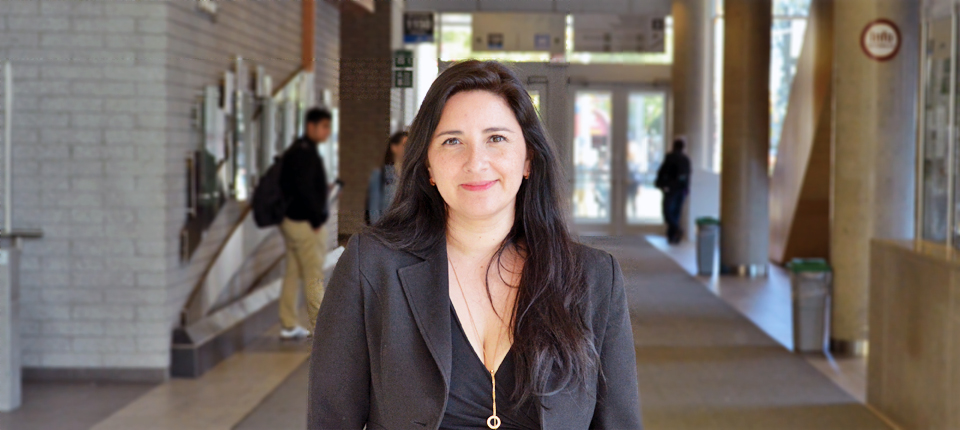
PhD Spotlight – Peyman Varshoei
Peyman Varshoei began the doctoral program in management at Telfer in 2017 after completing an MSc in socio-economic systems engineering. He is specializing in health systems under the supervision of professors Jonathan Patrick and Onur Ozturk. We interviewed him to learn more about his research into scheduling problems in health systems.
Why did you choose to study health systems?
I chose to do a PhD in management (health systems) because there are many research opportunities that could contribute to improving Canada’s health system. My previous degrees in industrial and systems engineering provided me with some techniques in advanced analytics that enabled me to work on complex problems in healthcare analytics, particularly patient and resource scheduling.
What is your research about and what will it contribute to academic literature?
My research concerns scheduling problems in healthcare, which includes hospital patient admission scheduling and home care nurse scheduling and routing problems. In my first study, I propose a scheduling policy that helps hospitals provide and maintain nimbleness during pandemic waves. It contributes by exploring how to strengthen pandemic wave recovery by preventing backlogs of elective surgeries that are postponed during the earlier pandemic waves. I am also introducing novel methods to solve rarely studied, complex nurse scheduling and routing problems in home care.
You recently presented your work at the Canadian Operations Research Society (CORS) conference. What are the highlights from that study?
At the CORS 2021 conference, I presented my first chapter: a “nimbleness” admission scheduling policy. I demonstrated how hospitals can schedule elective patients during pandemics in a way that maximizes elective admissions and also allows for quickly making some beds available for pandemic patients in the event of a surge.
What impact could your research have on Canadian health care?
My first thesis research shows policymakers and hospital managers ways to avoid massive cancellations of elective admissions during pandemics. The findings of my second research provide ways for policy and managerial decision-makers to increase both the efficiency of practice of home care nurses and patient satisfaction with home care services.
By Rania Nasrallah-Massaad
PhD Spotlight – Mary Valdes
Mary Valdes started the Telfer PhD in Management program in 2017, after completing a research-based MBA in Chile. She is a public accountant specializing in tax law.
Mary is training under the supervision of Professor Samia Chreim. Her main research interests are management accounting, management control systems (MCS), mining clusters, and small and medium-sized enterprise (SMEs) participation in global production networks. We interviewed her to learn more about her research on management accounting of small and medium-sized enterprises.
Why did you choose to study accounting?
Accounting was a natural choice for my PhD. I worked for 15 years as a public accountant, auditor and executive in several public and private sector organizations. My experience has shown me the tangible benefits of management accounting for firm success and survival. It is particularly important for SMEs, which are the most vulnerable firms and key to economic development.
What is your research about and how will it contribute to academic literature?
I research management control systems (MCS). My thesis uses multiple case studies with SMEs that are suppliers of the mining industry in Chile. I aim to describe their MCS and understand the factors that lead firms to choose their control configuration.
The study is novel and will provide a comprehensive assessment of the MCS and consider analysis for both the organizations and the individuals. It is also unique in that I am applying traditional frameworks of MCS in the context of the extractive industry in Latin America.
What are some of the highlights from your work?
My preliminary findings highlight that a diversity of control strategies exists among the firms, including some that have sophisticated control systems — a finding that challenges the MCS literature on SMEs.
SMEs use creative ways to exert control over their employees, resources and contractual commitments, and to cope with constraints they face due to limited available resources and a power asymmetry with their customers, the large mining firms.
The participants’ narratives showcase the industry’s requirements and contractual agreements, which generate control demands over them. However, it’s also emerging from the analysis that managers’ characteristics and background influence the choices of the control practices and nuances in their use, which could explain MCS diversity.
What impact can your research have on Canadian businesses?
Chile and Canada both have substantial mining and extractive industries where SMEs are crucial suppliers, so my work would also be informative to Canadian businesses. I hope my study brings insights into SME organization and spurs more academic attention, which is the first step to improving policy and support for SMEs.
By Rania Nasrallah-Massaad
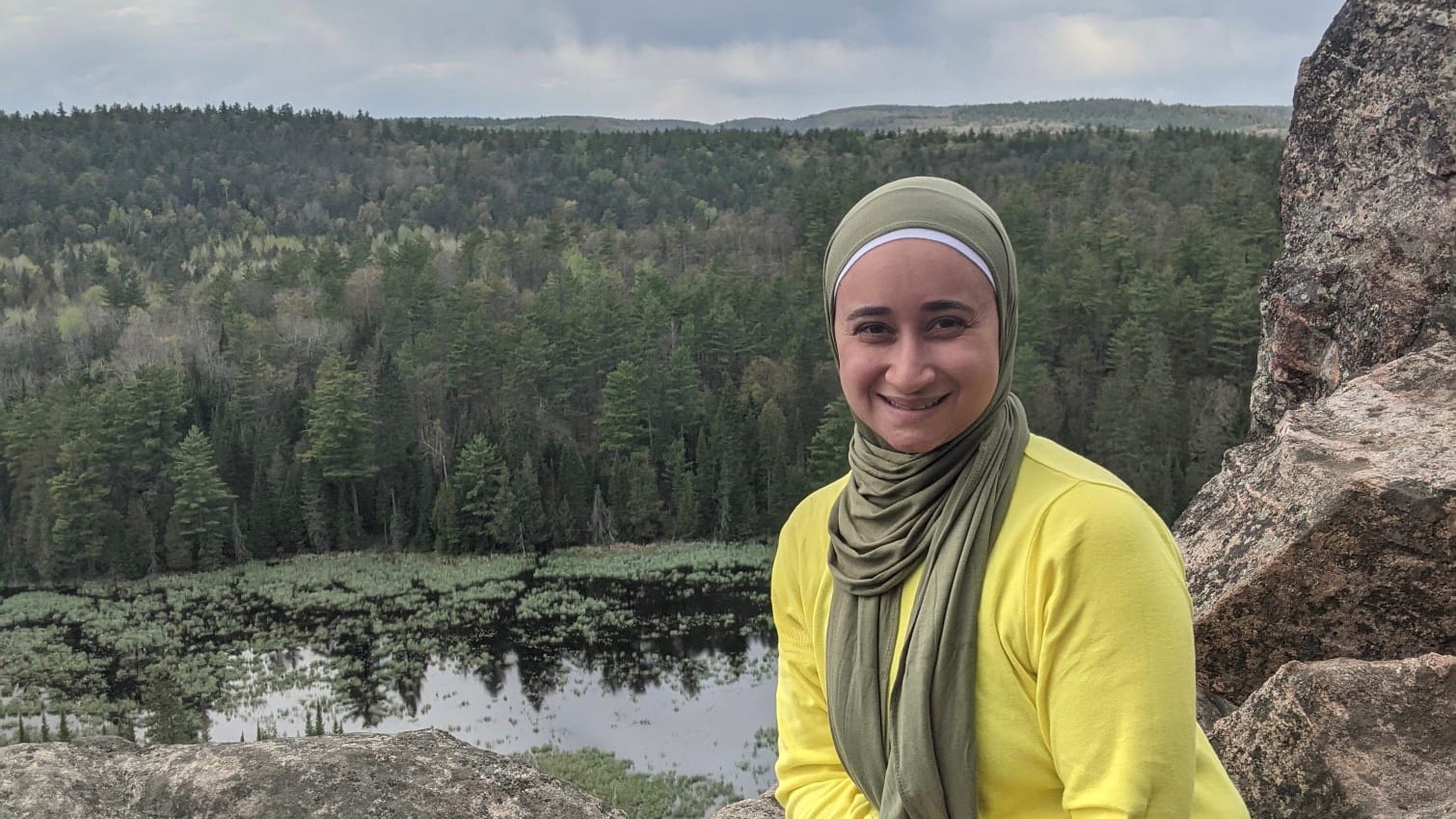
PhD Spotlight — Mariam Magdy Hussein
Mariam Magdy Hussein started a PhD in management in 2017, specializing in organizational behaviour and human resources, at the Telfer School of Management. She had earned an MSc from the German University of Cairo in 2014 and previously worked as an assistant lecturer in human resources management in management technology (2011 to 2014). Now, under the supervision of Professor Sharon L. O’Sullivan, Mariam has been looking at cultural variations in verbal and non-verbal communications, and the potential role of empathy in facilitating intercultural interactions.
Why did you choose to study organizational behaviour and human resources (OBHR)? Any personal motivation behind your interest?
I chose the OBHR stream because I enjoy listening to people’s stories about their experiences and their communicational interactions in different organizational settings. I’m particularly interested in finding ways to help underrepresented persons improve their experiences with their diverse counterparts in cases where miscommunication is routine and, in some cases, dysfunctional.
What is your research about and what will it contribute to academic literature?
My research is focused on underrepresented Middle Eastern newcomers’ groups in Canada. I’m eliciting their experiences in the health care service sector in terms of facilitators and barriers to effective communication and high-quality interaction. I’m also speaking to a sample of Canadian health care providers to understand their perspectives on interacting with newcomer clients. With my research, I will develop recommendations for training and orientation interventions for both groups to reconcile any perceptional differences and improve the quality of service provided.
Tell us about a recent highlight of your research.
I recently received the best student paper award at the 2021 Administrative Sciences Association of Canada (ASAC) conference. In my conceptual paper Behaving Culturally Empathic versus Being Culturally Empathic: Does Authenticity Matter?, I argue that perceptions of authenticity in intercultural interactions do matter for quality organizational interactions between cultural insiders and outsiders. I developed propositions that stimulate empathic and culturally intelligent interactions.
What impact could your research have on Canadian businesses?
My research underscores the challenges that many newcomers face in Canada within specific service provision organizational sectors. It will shed light on the positive and negative influencers of these interactions to develop concrete recommendations. These recommendations will support training interventions for Canadian service providers, as well as orientation services for newcomers.
By Rania Nasrallah-Massaad
- Using Social Enterprises to Address Community Hardship - Meet New Faculty Member Ana Maria Peredo
- PhD Spotlight — Andrea Ghazzawi
- Understanding What Stalls or Supports Social Change - Meet New Faculty Member Madeline Toubiana
- Levelling the Playing Field for Marginalized Market Actors - Meet New Faculty Member Myriam Brouard