CIHR Chair at the Telfer School Focuses on Gender, Work and Health Human Resources
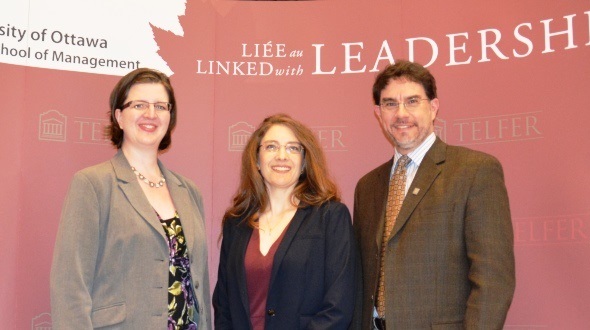 The Telfer School of Management is very pleased to welcome Ivy Lynn Bourgeault, new faculty member and the Canadian Institutes of Health Research (CIHR) Chair in Gender, Work and Health Human Resources.
“Professor Bourgeault is a tremendous addition to the Telfer School, a researcher who has garnered an international reputation for her work on health professions, health policy and women's health,” said Dean François Julien. “Her appointment enables us to contribute valuable knowledge on the links between gender, work and health and to deepen our research and teaching expertise in health systems management.”
Professor Bourgeault had been with the Faculty of Heath Sciences where she became a prolific researcher and leader in her field. She held the CIHR/Health Canada Chair in Health Human Resource Policy from 2009-2014. “Ms. Bourgeault has been a model applied chair - a key and respected leader in the community and champion of applied health policy research,” said Dr. Robyn Tamblyn, Scientific Director of the CIHR Institute of Health Services and Policy Research.
The new Chair awarded to Ms. Bourgeault is one of nine chairs in gender, work and health established by CIHR. “This new CIHR Chair will support research focusing on addressing critical knowledge gaps in the area of health human resources,” said Dr. Joy Johnson, Scientific Director of the CIHR Institute of Gender, Work and Health. “Ms. Bourgeault’s studies will increase our understanding of how gender influences quality of work, the types of task that are assigned to different health workers, and the movement of health professionals both within Canada and internationally.”
Ms. Bourgeault is the Scientific Director of the pan-Ontario Population Health Improvement Research Network, the Ontario Health Human Resource Research Network and the pan Canadian Health Human Resources Network. She has also developed active research collaborations with faculty at Telfer and she supervises students in the Master of Science in Health Systems Program.
Health Systems Management at the Telfer School
Long standing relationships with the University of Ottawa’s Faculty of Medicine, the Faculty of Health Sciences (including among others the Interdisciplinary School of Health Sciences and the School of Nursing), the Institute for Population Health and hospitals in the provinces of Ontario and Quebec have enabled the Telfer School of Management to position itself as a leading centre for expertise in health systems. The Telfer School offers two dedicated graduate-level programs in this area, the MSc (Health Systems) and (celebrating 50 years this May) the Master of Health Administration (MHA).
Photo: Cecilia Van Egmond, Assistant Director, Institute of Health Services and Policy Research, Canadian Institutes of Health Research (CIHR); Professor Ivy Bourgeault; François Julien, Dean of the Telfer School of Management.

A Closer Look at Hedge Fund Risk: Two New Studies by François-Éric Racicot
Professor François-Éric Racicot has made another strong contribution to a more nuanced understanding of hedge fund risk. A specialist in financial econometrics, Racicot has built on the prior literature to propose a new hedge fund return model that accounts for the new dynamics of financial markets and the cyclical behaviours of hedge funds.
Hedge fund risks have been implicated in the financial vulnerability that made the global financial crisis possible. A central focus in these investment vehicles is the use of aggressive trading strategies to optimize returns, including high leverage and borrow techniques to increase the amount of money available to risk. One estimate puts the value of the international hedge fund market at $2 trillion and it continues to grow.
One of the responses of researchers has been to confront the drawbacks inherent in conventional hedge fund return estimators and to propose improved methods. Racicot and Raymond Théoret of the Department of Finance, UQAM demonstrate that their hedge fund return model performs well empirically, and they also propose a new procedure for capturing measurement errors in asset pricing models. The researchers published their study in February 2014 in the journal Applied Economics and it is already being cited in graduate finance courses (including an intermediate-level Ph.D. course in applied econometrics at the Stern School of Business, New York University). In mid-2013, the team also published a study in the Journal of Journal of Derivatives & Hedge Funds which is considered to be one of the first to examine in detail the cyclical profile of hedge fund returns. The research demonstrated the value of further study of hedge fund return models in dynamic settings.
Hedge funds are a key element of the “shadow banking” system that in recent years has grown into one of the pillars of the financial system. However, the risk taking of a major hedge fund has the potential to create aggregate shocks that ripple throughout the financial system. Moreover, pension funds savings are increasingly invested in hedge funds in response to the downward trend seen in conventional savings vehicles. The implications of Racicot’s ongoing research on hedge fund return models are therefore attracting interest well beyond academia.
Associate professor of finance at the Telfer School, Racicot teaches finance and applied econometrics. He has published several graduate-level texts in quantitative finance and financial econometrics and is a member of the editorial board of several highly-regarded journals. He is an advisory board member of the financial journal: AESTIMATIO-The IEB International Journal of Finance. He contributes to the CGA-Canada Accounting and Governance Research Centre at the University of Ottawa. He is also a research associate at the Corporate Reporting Chair at l'Université du Québec à Montréal (UQAM).
Articles cited:
"Cumulant Instrument Estimators for Hedge Fund Return Models with Errors in Variables", Applied Economics, 2014, Vol. 46, No. 10, 1134-1149.
"The Procyclicality of Hedge Fund Alpha and Beta", Journal of Derivatives & Hedge Funds, Vol. 19, 2, 109-128.
M.Sc. Health Systems Candidate to Present Thesis Research at International Conference
M.Sc. Health Systems candidate Emily Rowland will attend an international conference this week to present her research examining the maternal experience in a neonatal intensive-care unit (NICU) environment.
Working under the supervision of Dr. Ivy Bourgeault and Dr. Muriel Mignerat, University of Ottawa, Rowland is exploring the significance of the relationships between neonatal nurses and mothers. The research examines how nurses can include mothers in the care processes to improve their experience in the NICU. Using an institutional ethnographic framework, data will be collected through participant observation, interviews with mothers in the NICU and textual artifacts. This research will be of interest to neonatal nurses and unit managers as it will provide information on how care delivery can influence mothers’ feelings and wellbeing.
Ms. Rowland presents her paper at the Academy of Neonatal Nurses 11th National Advanced Practice Neonatal Nurses Conference in Honolulu, April 23-26, 2014.

Professor Doug Angus Participated in a Roundtable of Leading Experts on Health Systems Reform
Professor Doug Angus contributed to an experts roundtable organized by the Institute for Research on Public Policy on March 20. The focus of the roundtable was to explore this question: “What are the structural, financial and governance barriers that prevent healthcare reforms? How can we break them down in a way that leads to the creation of an effective and efficient health system.”
Full Professor at the Telfer School of Management with expertise in health economics and health policy, Doug Angus teaches in the M.H.A. and M.Sc. Health Systems programs. He has research activities at the international, national, provincial and regional levels in areas related to health economics, health policy, program evaluation and healthcare management.

Telfer Professors Publish Report On Challenges and Best Practices in Mentoring for Diversity
 In a new report Catherine Elliott and Joanne D. Leck examine the state of mentoring in Canada and some of the challenges faced by women, visible minorities and immigrants, disabled persons and Aboriginal people in advancing to senior positions in the workplace. Professors Elliott, Leck and their research team document how mentoring is associated with numerous benefits, including improved work performance, promotions, and enhanced skills development. They examine various approaches to mentoring and aim to discover how best to leverage mentoring as a tool to promote employee learning and advancement in order for Canada to access the leadership potential of all employees.
 Organizations have increased their investment in mentoring programs in response to competition for knowledge workers and a shortage of leadership talent, but there is a lack of compelling evidence that the current programs work well for designated groups, who remain underrepresented in management and in positions of power, the researchers conclude.
Canada would benefit from evidence-informed policies to achieve sustained mentoring programs which incorporate development and training of mentors, the authors explain. “We need to think of mentoring as a deliberate and focused learning process, not an occasional ‘let’s have coffee’ once in a while experience, in order to truly to break through the glass ceiling".
This study was funded by the Social Sciences and Humanities Research Council of Canada (SSHRC) through a Knowledge Synthesis Grants competition that focused on skills development for future needs of the Canadian labour market. Sixteen reports by researchers across Canada from a range of disciplines were funded through this initiative.
Links to these reports and accompanying short videos have been posted by SSHRC.