Professor Jonathan Li Awarded Grant from the Natural Sciences and Engineering Research Council of Canada
Professor Jonathan Li of the Telfer School of Management has been awarded a grant from the Natural Sciences and Engineering Research Council of Canada (NSERC) for research centring on the modelling and optimization of risk measures. This work aims to develop a risk measure capable of capturing multifaceted uncertainty. Professor Li, an assistant professor at the Telfer School since 2013, holds a Ph.D. from the Mechanical and Industrial Engineering Department at the University of Toronto specializing in business analytics, operations research, and financial engineering.
Research Summary
More sophisticated measures of risk and uncertainty have emerged in response to deficiencies found in traditional risk measures that have led to risk underestimation. (The 2008 financial crisis offered a dramatic recent example of the far-reaching effects of underestimating risk.) New measures developed within the fields of Robust Optimization and Risk Analysis have been particularly encouraging. A significant part of these efforts has been focused on designing a class of measures that respect fundamental principles of risk management, namely convex risk measures. The theme of this research program is to develop methodologies that enable convex risk measures to be customized according to decision makers’ knowledge of risk and to be minimized subject to constraints facing each decision maker. Such a customization will provide a broader view of risk than the traditional one based on probability assumptions. This research program offers the potential to account for the uncertainties facing decision makers in a more comprehensive way, one that applies to decision-making in fields such as finance, health care and energy. The work extends professor Li’s research on the issue of model uncertainty, which arises when the mathematical model used to describe a decision problem is prone to error. Professor Li will receive a $110,000 grant from NSERC over five years.
Telfer-Sprott Research Forum 2014 Focused on Performance Management
The 5th Annual Telfer-Sprott Research Forum 2014 was held on April 24, 2014 under the theme The Performance Challenge – New Questions, Recent Management Approaches. Building upon the success of the previous forums, this event provided a unique opportunity for faculty members to exchange research knowledge and form new linkages that will lead to ongoing collaborations. The conference heard from two keynote speakers, Toby Fyfe of the Institute on Governance and Daniel Watson, Chief Human Resources Officer, Government of Canada. Lysanne Lessard, Telfer School of Management discussed “Modeling Service Performance in Knowledge-Intensive Business Service (KIBS) Engagements: Toward Effective Tool Support.” François Brouard and Leighann Neilson of the Sprott School of Business presented their analysis of change in fundraising activities in small charities. Walid Ben Amar from the Telfer School examined boards of directors through the lens of sustainability management. Niraj Bhargava from the Sprott School presented “Entrepreneurship and Sustainability: Academic and Applied Research with a Sustainable Energy Agenda Example.” And Mika Westerlund from the Sprott School discussed strategies and management roles for sustainability innovation. The event concluded with the announcement of the 2014 winning project under the Telfer-Sprott Research Fund, led by Samir Saadi of Telfer.

Professor Samir Saadi Awarded Grant for Study of Value Based Management
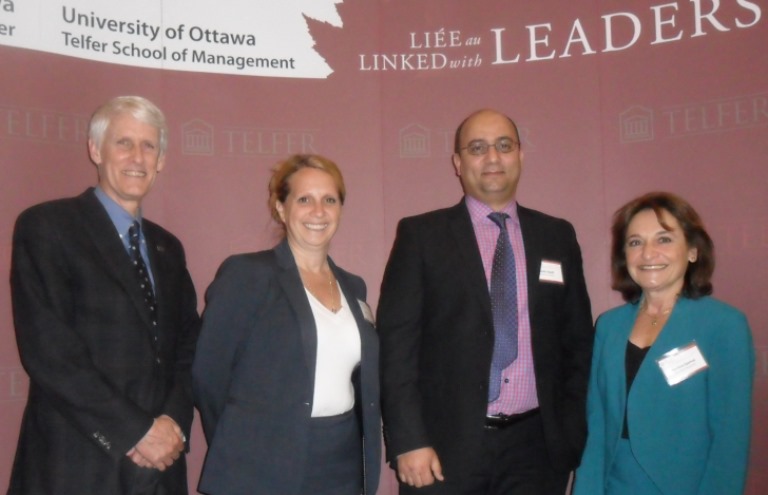
Samir Saadi is the lead investigator in a project to be funded by the Telfer-Sprott Research Fund. His project, “Does Value Based Management Performance Affect CEO Turnover and Compensation?” will receive $10,000 over two years, it was announced at the Telfer-Sprott Research Forum at the end of April. Saadi is an Assistant Professor of Finance at the Telfer School.
Description of the Project
There is a general consensus among academia and practitioners that capital markets reward firms that focus on value-based management (VBM) practices and long-term value creation. VBM is commonly measured using Economic Value Added (EVA) and Market Value Added (MVA). The existing literature, however, puts a great deal of emphasis on the relationship between value creation and stock return performance. Samir Saadi with colleagues Vijay Jog, Carleton University and Shantanu Dutta, University of Ontario Institute of Technology seeks to extend the literature by examining whether tenure and compensation structure of senior managers would be tied to relevant VBM performance metrics of the firm. The team will also investigate whether the quality of corporate governance influences the relationship between a firm’s performance, and probability of CEO turnover and compensation structure. Finally, they will examine whether and how the recent financial crisis affected the relationship between a firm’s performance and compensation structure and the probability of CEO turnover. An empirical analysis will be conducted using a sample of S&P 1500 firms from the years 2002 - 2013.

New Study Highlights Impact of Ostracism in the Workplace
Ostracism matters at work. How bad is the problem? New research led by the Telfer School’s Jane O'Reilly provides consistent empirical evidence of the impact of ostracism in organizations. “Employees are likely to believe the behaviour is relatively mundane and innocuous given its indirect nature,” explained professor O’Reilly. “What we found was that being left out of the social circle can actually be quite negative.”
Ostracism was defined in the research as social exclusion, including behaviours such as having one’s greetings go ignored, being excluded from invitations, or noticing others go silent when one seeks to join the conversation. Across three studies, O’Reilly and her team surveyed employees in a wide range of workplaces for their views on ostracism versus other forms of mistreatment at work (collectively referred to in the study as harassment). Ostracism was found to be more strongly and negatively related to a sense of belonging, and to various measures of employee well-being and work-related attitudes. Ostracism, but not harassment, also significantly predicted actual turnover.
The research suggests that organizations should take social exclusion at least as seriously as other, more obvious acts of mistreatment in the work environment, said professor O’Reilly, an assistant professor of organizational behaviour who studies informal interactions and relationships in organizations. She cautioned that the result is not intended to challenge the current focus of anti-bullying polices and harassment policies, only to lend support to the idea of ostracism as a distinct form of workplace mistreatment meriting further study. “Employees have a strong need to belong in their organizations, and there’s persuasive evidence in our study that social exclusion can be more threatening to that than harassment,” O’Reilly explained.
Understanding the impact of ostracism better, however, is not the same as knowing what to do about it in practice, which remains a grey area. “Ostracism may be difficult for someone to observe in order to determine that someone is being socially excluded.” And if the conduct can be observed, can it be discouraged? “It is hard for a manager to say, ‘you have to bring so-and-so to lunch with you,’ or ‘or you have to say hello to everyone when you enter.” Workplace rules explicitly address verbal and physical behaviours that actively demean or threaten another employee. It is comparatively rare to find, however, personnel rules and guidelines that address the issue of socially excluding an employee from formal or informal interaction, O’Reilly noted. Whatever the remedy, “promoting inclusive policies will likely be a lot more effective than punitive policies.”
She said that organizations can also educate management and employees about the nature and consequences of ostracism and help employees to learn more direct and effective methods of conflict resolution and managing their relationship tensions. Given the results showing the prevalence of ostracism and its relationship to employee well-being, work-related attitudes and turnover, there is room for further studies that will have both theoretical and managerial implications, O’Reilly added.
“Is Negative Attention Better Than No Attention? The Comparative Effects of Ostracism and Harassment and Work” was published online in the journal Organization Science, April 4, 2014 and forthcoming in the print edition. The researchers are Jane O’Reilly, Telfer School of Management, Sandra Robinson, Sauder School of Business, University of British Columbia, Jennifer L. Berdahl, Rotman School of Management, University of Toronto, and Sara Banki, Graduate School of Management and Economics, Sharif University of Technology, Tehran (Iran).

Laurent Lapierre is Co-editor of a New Book on Leader-Follower Dynamics
Professor Laurent M. Lapierre of the Telfer School of Management is the co-editor of a new book, Followership, What Is It and Why Do People Follow? (with Melissa K. Carsten of Winthrop University, USA). This work offers a collection of chapters written by thought leaders on this increasingly popular topic.
The term "follower" has traditionally been given negative connotations (images of sheep, "yes people," or mindless subservience come to mind). However, organizations can't have true leadership without some form of followership. Managers who have no followers are NOT leaders. Followers support those they consider their leaders. They enable leaders to exist.
With organizations much more reliant on followers now than in the past, particularly followers who show independent thought and constructively challenge their leaders, it is an especially opportune time to see followership in a different light. The follower role has truly evolved over time, just as the distinctions between followers and "non-followers" have become more visible and important. While leadership development receives the lion's share of attention in business education and a great many other fields of human endeavour, followership is integral to leadership and goes to the heart of how employees can gain the leadership they need from their superiors.
- CIHR Chair at the Telfer School Focuses on Gender, Work and Health Human Resources
- A Closer Look at Hedge Fund Risk: Two New Studies by François-Éric Racicot
- M.Sc. Health Systems Candidate to Present Thesis Research at International Conference
- Professor Doug Angus Participated in a Roundtable of Leading Experts on Health Systems Reform