Questions for... Michael Parent

Michael Parent is a Full Professor of Marketing at the Telfer School. He was previously a Full Professor of Marketing and Management Information Systems at the Beedie School of Business, Simon Fraser University in Vancouver. Before that, he was an Assistant Professor at the Richard Ivey School of Business, Western University.
Much of your research explores themes at the intersection of marketing and management information systems. Can you elaborate?
My Ph.D. was in fact concentrated in these two disciplines. I’m very interested in issues relating to e-business, cybersecurity, and social media. From the companies’ perspective, without the data they obtain from online activities, they are unable to target their marketing efforts. There might otherwise be high marketing overhead to attract customers. The marketing costs are baked into pricing and people sometimes don’t make that connection.
If a company can use data get a read on a customer, that’s efficient. They can do that by mining your tastes, by compiling details about your consumption preferences. So from one perspective, online marketing does create efficiencies. From the customer’s perspective as well—if you are in the market for a good or service—there’s efficiency. Would you rather have 2 channels with 20 things you watch or 10 channels with 500 things you never watch?
What about the downside?
The prevailing wisdom is that nothing is private anymore. Because a lot of it is so bit-based, through cookies, through tracking, through click-throughs on ads, online marketing can become invasive. The retailer Target faced criticism three years ago after sending coupons for baby items to a teenage girl. By sorting data on her buying history, the company predicted with a high level of confidence that she was pregnant. They “knew her” better than her father did. He was naturally furious, and a backlash against Target ensued.
It is very easy to find similar examples where data mining infringes on norms of privacy. So there’s a question that continually arises about the appropriate balance between anticipating and responding to consumer needs and marketing in an effective and efficient manner versus invading somebody’s right to be left alone, essentially.
Can you also talk about your interest in governance practices at board level? Previously, you were director of the CIBC Centre for Corporate Governance and Risk Management at the Beedie School of Business.
I’ve definitely been interested in this area as an educator, as I teach across the country in the Directors Education Program, jointly developed by the Institute of Corporate Directors and the Rotman School of Management. However, I have also been interested in issues of corporate governance as a researcher. I have recently begun a project with a colleague at Telfer School, Professor Joanne Leck, for example. This research examines what we mean by diversity at the board level, and seeks to understand better the extent to which board diversity and firm performance are linked. The topic is especially timely, as it is the first year that public companies are required to indicate whether they have a board diversity policy in their filings. Under the OSC’s “comply-or-explain” rule, firms that have not set out a board diversity policy are required to explain why they have not.
Canada has a gender-equal cabinet for the first time. Can federal politics move the debate about diversity in corporate boardrooms?
I think it can, and certainly Trudeau’s response to the issue is a sign of the times. The explanation he gave – “it’s 2015”— is the perfect response. However, there is no doubt that important systemic obstacles will have to be overcome for the same to be achieved in the corporate world. The research is very preliminary, but indicates that that the reason cited for not having a board diversity policy seems to be “we don’t discriminate against anyone, for any reason, period; to impose any kind of a quota would be discriminatory.”
To say that theoretically is fine, but it’s complete hogwash when you look at the composition of the boards in Canada, which have been generally acknowledged to be “pale, male, and stale” (as one of my colleagues so memorably puts it). Our research tries to examine the institutional causes and the extent to which they could be challenged. Finally, we also acknowledge that gender is only one facet of board composition. So the project seeks to develop a more nuanced and fuller definition understanding what we mean by performance-related diversity at the board level.

Family: Not necessarily a factor in women entrepreneurs’ business growth intentions

"Family-related issues" – sometimes said to be more meaningful to women entrepreneurs than to their male counterparts – might not be all that consequential to their business growth intentions . According to Professor Laurent Lapierre and M.Sc. in Management student Ruoxi Xia, what seems more relevant is whether or not people important in women entrepreneurs’ lives, whether they happen to be family members or not, want them to grow their business.
Study Purpose
We investigated how family-related experiences of women entrepreneurs, including their work-family conflict and work-family enrichment, relate to their intentions to grow their business. Work-family conflict occurs when family roles and work roles are incompatible with each other (such as having less time for family activities because of business-related obligations). Work-family enrichment refers to experiences in one role making it easier to perform well in the other role (such as acquiring knowledge or skills at home that are also useful on the business front). Previous research suggests that women entrepreneurs are more likely than their male counterparts to be influenced by family issues when making business growth decisions. Intention to grow is a key determinant in whether the business succeeds. To further study this issue, we examined whether women entrepreneurs who experience less work-family conflict and more work-family enrichment are more willing to grow their business.
Sample Used
Our target population was Canadian female entrepreneurs who run and own (or co-own) a business having less than 500 full-time employees, and have family demands, such as having at least one school-aged child, or living with a partner/spouse, or providing weekly care to elderly parents/close family members. In total, 116 women entrepreneurs meeting those criteria participated in our study by completing an online questionnaire. The average participant was 46 years old and had 15 years of work experience in her business’ industry. Almost half of our respondents ran a business that was five years old or less. Most devoted 45-54 hours per week to their business and had 1 to 9 full-time employees.
Findings
Overall, we found little association between women entrepreneurs’ experience of work-family conflict or enrichment and their business growth intentions. However, we did find that the more women entrepreneurs believed that important people in their lives wanted them to grow their business, the more they were willing to grow it. While important people may include family members, such as one’s spouse, they may also involve people outside of the family, such as clients and business partners.
Implications
To the degree that a woman entrepreneur wishes to more easily grow her business, our findings imply that she should strive to surround herself with people whose opinion she values and that would be encouraging of her business ambitions. These people may include family members as well as people outside of her family.
If you have any questions about the study, please contact Dr. Laurent M. Lapierre at This email address is being protected from spambots. You need JavaScript enabled to view it. .
The Power of Feminine Capital
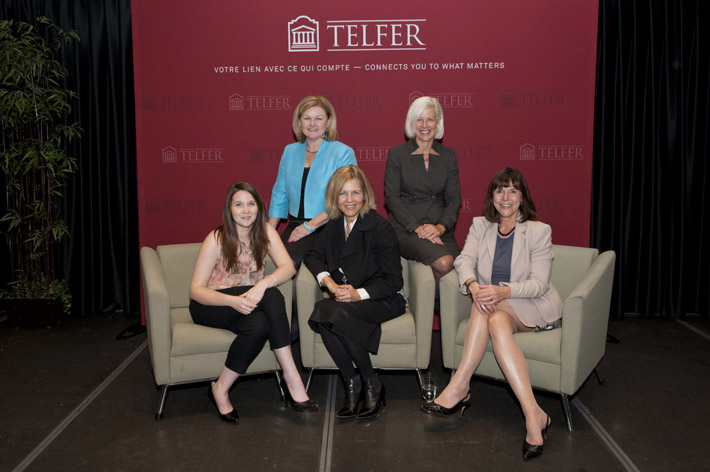
To help kick-off Global Entrepreneurship Week, on Monday, November 16, 2015, the Telfer School of Management and uOttawa E-Hub hosted a book launch and panel discussion about strategies to grow female-owned enterprises. Drawing on over four decades of research, Dr. Barbara Orser and Dr. Catherine Elliott’s work Feminine Capital ‘Unlocking the Power of Women Entrepreneurs (Stanford University Press, 2015) offers new insights into the ways that gender can influence entrepreneurial decision-making.
Panelist Teri Kirk (CEO, The Funding Portal), Janet Longmore (CEO, Digital Opportunity Trust), and Kathleen Kemp (Cofounder, CIGBINS), discussed how adoption of digital technologies is enabling global engagement and enterprise growth.
- Lesson1: Fast growth enterprises are willing to learn and grow with nascent technologies. Janet Longmore, CEO of Digital Opportunity Trust, launched her multi-nation enterprise at the same time as SKYPE was entering the market. With a head office in Ottawa, deploying emerging technologies and engaging youth in both content creation and delivery have helped to ensure that this 'born global' social enterprise is a market leader in delivering community-based training around the world.
- Lesson 2: Fast growth companies capitalize on the power of the Internet. The Founding Portal CEO, Teri Kirk, shared insights about how her for-profit enterprise has deployed aggregation technology and on-line information to become the "Travelocity of funding for small- and medium-sized enterprises." Today, this bilingual, one window gateway is helping Canadian business access over 7,000 sources of government funding.
- Lesson 3: The power of a cellphone cannot be underestimated. Telfer alumni and co-founder of CIGBINS, Kathleen Kemp, described how technology, such as her cellphone, enabled this environmentally-focused enterprise to launch and scale quickly, engaging multiple stakeholders in the start-up process.
“We found that gender effects are realized in many ways, in entrepreneurial decisions and assumptions, through actions and interaction”, said Barbara Orser. “We’ve also learned that women embrace a continuum of perspectives about how gender impacts the way one does business. For some women, being female has no influence on their business practice. For others, it’s all about being female. Women spoke about how they are using experience to recognize new markets, to build brands and to drive profits.”
“The book also introduces the concept of entrepreneurial feminism. We spoke with women who are infusing feminist values through their entrepreneurial activities. They see themselves as change agents, empowering others, and in particular girls and women. Many seek women business owners to do business with. They prioritize relationship and see exchange as a means to collaborate rather than compete. By doing so, female entrepreneurs are leveling the economic playing field, one venture at a time” said Catherine Elliott. “We then translated research into practical advice, tips and learning aids by using the words of the women we encountered in our studies.”
Based on research with over 20,000 entrepreneurs, this book provides a fresh perspective about the intersection between entrepreneurship and gender. Building on their peer-reviewed studies, the authors consolidate lessons learned to answer three questions:
- What is feminine capital?
- How is feminine capital transforming entrepreneurship?
- How does entrepreneurship inform feminism?
The book should be of interest to researchers, students of entrepreneurship, management and gender studies, and those who influence entrepreneurs, including bankers, industry and sector associations, and policymakers. For further information, including sample content and book reviews visit the Feminine Capital book page.

Gilles Reinhardt, new professor in business analytics

Gilles Reinhardt has joined the Telfer School of Management this year in the Business Analytics Section. Professor Reinhardt researches how business analytics and operations management can contribute to the efficiency and effectiveness of healthcare delivery. He will draw on his academic and professional experience to explore how delivery processes can be designed or improved to best serve industry, providers and beneficiaries alike.
“Quality of care and efficiency are often perceived as misaligned goals in the healthcare realm,” notes Reinhardt, who holds a Ph.D. in operations management from the Kellogg School of Management at Northwestern University. “This often leads to conflict and friction in the upstream portion of the supply chain which in turn can compromise critical interactions in its downstream portion, namely the provider-patient relationships.”
The resolution of such conflicts at the production and manufacturing level has paved the way for innovative solutions that have significantly improved the agility, responsiveness and efficiency of supply chains. While witnessing, taking part in, or disseminating examples of those successes in classrooms and research, Reinhardt identified similar concerns in a variety of healthcare settings. “Long wait times for specialty interventions, critical bottlenecks in emergency services, excessive costs and delays for vital material and supplies, and the set-up of large and complex care pathways: these can all be approached through a careful adaptation of proven concepts that have yielded success and satisfaction across the supply chain constituency.”
Reinhardt returns to Ottawa after spending over twenty years in Chicago, an international nexus of operations, transportation, manufacturing, and service. “That city has an impressive track record of pragmatic private and civic achievements, conceptualized through complex and innovative designs and realized with ground breaking problem-solving accomplishments. Soaking up this inspiring environment every day was a big motivator for my research and my teaching.”
Reinhardt’s current research interest focuses on prescription drug access, availability and cost. He will be teaching courses in business analytics and in operations management. “Those were my two favourite courses as an undergraduate here back in the eighties. Now I get to teach them to the next generation. What an amazing honour!”

David Crick joins Telfer as the Paul Desmarais Professor of International Entrepreneurship

The Telfer School welcomes David Crick as a full professor in entrepreneurship. Professor Crick has more than twenty years’ experience in research, consultancy and teaching in the U.K. and New Zealand where he also held full professorial roles. His current research focuses on start-up firms with limited resources and an evolving lean business model, of which internationalization processes and the support requirements of entrepreneurs are a core aspect.
Professor Crick says one of his core philosophies is to undertake research that informs students and practitioners while contributing to academic theory. This includes studies that help create an effective ‘ecosystem’ for entrepreneurs to thrive via work with various networks of policy makers, incubators, investors and the entrepreneurs themselves.
“I’m of the firm belief that entrepreneurship should be supported from a whole range of different dimensions,” says Crick, the Paul Desmarais Professor of International Entrepreneurship and Marketing. “In Ottawa, you certainly have, at least in theory, the opportunity for a lot of deep entrepreneurship learning to take place, and it will happen as the public, private and university sectors come together to create the kinds of ecosystems where entrepreneurs can identify and exploit growth opportunities.”
Critical to these ecosystems is the internationalizing processes successful start-ups employ to reach overseas markets. In this respect, New Zealand, where Crick was recently Professor of International Entrepreneurship at Victoria University in Wellington, provides an interesting example for Canada. Entrepreneurs there are obliged to address the international dimension in their business plans – right from the start, says Crick. “Otherwise, their funders aren’t going to make any money (New Zealand is a country of just over 4 million people). In the first 12 months, entrepreneurs have to start validating their business models with international markets in mind.”
And yet internationalization represents only one dimension of entrepreneurship. “It is obviously a goal for many start-ups. I don’t dismiss that in any way, but I do think that is a restricted view: this isn’t a priority with everyone.” There are many examples of small lifestyle businesses in tourism and hospitality in this category, he says.
Not-for-profits, too, are an important and interesting area of entrepreneurship in their own right. “One thing that I have noticed here in Canada, much more than the U.K. and New Zealand, a lot of the students in some of the entrepreneurship classes are interested in not-for-profits, and it’s something we should be supporting them with if that’s their goal.”
The sheer diversity of projects that can interest the students is actually a key aspect of entrepreneurship that makes it a rewarding subject to teach, says Crick. This offers opportunities for postgraduate study at the master’s level as well as in the new Ph.D. programme starting in 2016.
“What is exciting about the entrepreneurship field is the opportunity to support the great variety of ideas and projects that interest entrepreneurship students and to facilitate their engagements with practitioners and policy makers – to support all of the objectives that budding entrepreneurs might be pursuing.”