
Taking the surprise out of risk measurement
Accurately quantifying financial risk calls for innovative approaches, says Professor Jonathan Li.
Current risk management practice can come with unpleasant surprises – the result of excessive risk-taking and a false sense of security among investors. Quantitative finance experts, or “quants” as they are known in the trade, masked the true picture of financial risk in the run-up to the 2007-2009 financial crisis using models that failed to connect to human behaviour. With his studies focused on improving the conventional measures of risk,
Professor Jonathan Li is among a handful of researchers seeking to close a significant gap between the theory and the practice of risk management in quantitative finance.
The crux of any financial risk management is reaching consensus about the tolerance for risk, whether between a money manager and an owner, a portfolio manager and a client, or a bank manager and a stakeholder. But it turns out that getting two parties to spell out what they actually mean by risk, let alone reach a consensus, is much harder than people realize. As the business press has also discovered, this problem continues to vex money managers and encourage future financial instability. So there’s an urgent need for a risk measure capable of reaching such a consensus.
“The development of a new risk measure must go beyond the conventional mathematical models,” says Li. “We are not throwing out the quants altogether; we’re saying their models don’t properly reflect people’s actual tolerance for risk. We really need to address this, or else we miss an opportunity to take the right lessons from the financial crisis.
“Instead of serving the purposes they were intended for, current risk-measurement models tend to do just enough to get by regulators. The financial industry’s position is ‘no risk, no return.’ But how do you define acceptable risk? We argue that risks should not come with so many unexpected surprises.”
What is claimed to be a risk-adverse solution may actually be a very risky one for a client, according to Li. So the critical question is how to elaborate a risk measure that reaches the limits of risk tolerance – but goes no further.
Using business analytics tools like optimization and statistical learning, Dr. Li and his colleague show for the first time that it is possible to account precisely for the risk tolerance of an investor when comparing and optimizing financial decisions. Their methodology, described in an article in the FT50 journalManagement Science, presents the opportunity to make financial decisions better aligned with individuals’ risk tolerance.
Li acknowledges that in any situation where people must make decisions based on incomplete information, there is always a role for ‘gutsy decisions.’ But they need not be fraught with risk.
“It’s not an either/or issue," says professor Li. "You can make gut-level choices and stay clear of your personal risk tolerance limits and worse-case scenarios.”
Study upends conventional thinking about government grants to not-for-profits
A Telfer School study has found that higher program spending ratios are not consistently helpful to Canadian not-for-profits (NFPs) seeking government grants, overturning common assumptions.
“This finding goes against some conventional expectations about the impact of program spending ratios – the ratio of reported program expenses to total expenses,” said accounting professor Shujun Ding.
NFPs with higher program ratios tend to do better in the donor community. They’re believed to be more accountable, spending relatively more of their revenues on programs and services than administrative and fundraising activities. So it might be expected that higher program ratios would be consistently preferred by governments in their grantmaking decisions.
Not so, say the researchers. Whereas donors emphasize accountability, governments are more focused on reliability: they tend to make grants to organizations with higher administrative ratios.
“This finding is really about governments placing greater confidence in organizations that hire professional management, train staff and upgrade their information systems – the kinds of things that increase administrative costs,” explained professor Ding, who with Qiu Chen and Walid Ben Amar conducted an analysis of 85,398 charities from 2003 to 2013. “So to some extent, the higher administrative ratios are capturing the professionalization level of nonprofit organizations.”
In another respect, governments aren’t fundamentally different from donors when making funding decisions. The researchers demonstrate that governments, like most sophisticated donors, are capable of identifying poor quality of accounting information. They react to it by being less likely to fund, and to fund less.
This study provides clear evidence that governments pay close attention to the quality of accounting information in their grant-making decisions. But it also contains a practical takeaway for charity managers, professor Ding noted. “NFPs that rely heavily on government grants need to think seriously about putting a greater number of resources into improving their administrative infrastructure and reliably delivering programs.”
The findings are discussed in a working paper presented recently at the midyear meeting of the American Accounting Association’s Government and Nonprofit Section. This study is one of severalprojects funded recently by the CPA Accounting and Governance Research Centre.

Daina Mazutis wins a prestigious EFMD case writing prize
Daina Mazutis has just won the prestigious international EFMD Case Writing Competition in the “Sustainable Production Systems” category. Mazutis, the Endowed Professor of Ethics, Responsibility and Sustainability at the Telfer School of Management, won a 2,000€ cash award for her case “Newlight Technologies: Plastics For A Carbon Negative Future.” Her case, coauthored with Daniel Day, centres on a California-based company, Newlight Technologies, which developed a way of employing greenhouse gas emissions as a resource to make plastic, using carbon-capture technology.
The EFMD Case Writing Competition is organized annually by the Brussels-based business-school accreditation body EFMD (The Management Development Network) with the aim to encourage and support the writing and creation of new and innovative case material. Candidates adopt a critical perspective on the different dimensions of the subject of investigation and are judged, among other criteria, on the ability to create a strong and interesting learning experience by including contentious issues and multiple perspectives.

New University Research Chairholder Craig Kuziemsky says: ‘Now is the time to seize next big opportunity in healthcare innovation’
The University of Ottawa has awarded Professor Craig Kuziemsky a University Research Chair in Healthcare Innovation. Professor Kuziemsky’s research program will centre on the creation of a data-driven framework supporting healthcare innovation driven by collaborative interprofessional teams.
Professor Kuziemsky explained that the challenges associated with rising healthcare costs, an aging population and the emergence of personalized medicine have created an unparalleled opportunity to create value for patients and society by focusing on the business of healthcare.
“The business of healthcare refers to how the system coordinates clinical services, tracks patient pathways and illnesses over time, and shares information and data across different providers,” noted Professor Kuziemsky. “In Canada, we’ve made excellent strides at clinical innovation but we fall short in regards to business of healthcare innovation. This holds back transformative initiatives like collaborative care delivery, chronic disease management, and patient-centered care. We require innovative solutions to redefine the rules of how healthcare is managed to support these new paradigms.”
The central theme of Kuziemsky’s research is the move from individual workflows characterized by provider-centered practices into a patient-centered collaborative teamwork. As increasing complexity in patient care demands the involvement of multiple providers across multiple clinical sites, a lack of coordination has been identified as a core issue hampering healthcare reform. “We need to innovate to break silos down and make collaborative teams of providers work successfully. The provision of safe and efficient patient-centered care requires individuals to step outside their silos and become integrated into collaborative teams.”
Getting there will require an understanding of how providers and clinical processes interact with information, Professor Kuziemsky cautioned, highlighting the interdisciplinary character of his research. “Business of healthcare concerns relating to patient safety, collaborative care delivery, and the inclusion of best evidence into everyday practice are not technical issues per se. These problems cannot be solved just with technology; they call for change management and a multi-faceted approach.”
Over the past few years, the Telfer School has expanded its health systems management group and strengthened the involvement of primary and tertiary care organizations in research and teaching. Dr. Kuziemsky’s vision combined with his health practitioner focus exemplifies this approach. His appointment puts the Telfer School at the centre of a dynamic research ecosystem that will generate evidence-based healthcare innovation in support of the business of healthcare. “Sustainable healthcare in the 21st century isn’t strictly a medicine challenge, but neither is it purely an analytics or information-science challenge,” notes Kuziemsky. “The business of healthcare really requires that management insight: taking what we know from business, and using it in an innovative way to provide better health at a better value for Canadians.”
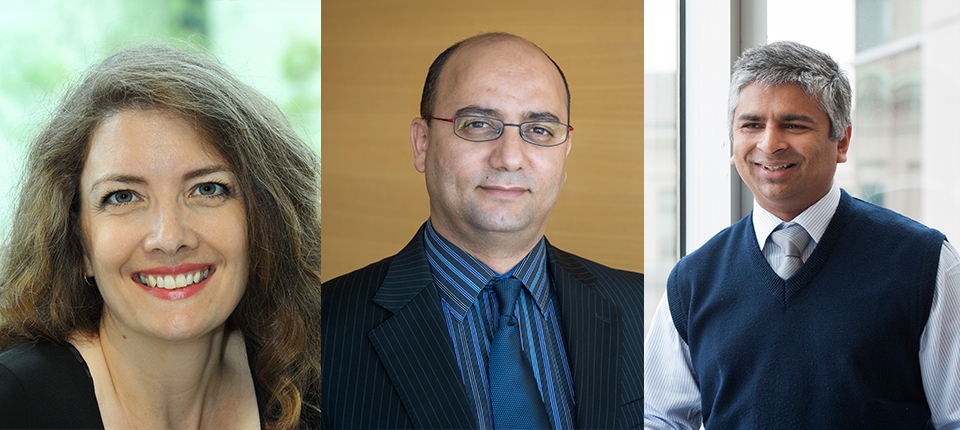
Professors Bourgeault, Saadi, and Dutta honoured at Dean’s Assembly
Congratulations to the winners of the Telfer School of Management Research Excellence Awards, which were announced at the Dean’s Assembly on June 7, 2016:
- Ivy Lynn Bourgeault - Established Researcher Award
- Samir Saadi - Up-and-Coming Researcher Award
- Shantanu Dutta - Innovative Researcher Award
About the winners
Ivy Lynn Bourgeault - Established Researcher Award
Professor Bourgeault was recognized for her outstanding contributions in research and to the academic community. Professor Bourgeault was the recipient of numerous grants and awards from the tri-council agencies and is the author of nearly 140 peer-reviewed publications. She has achieved significant impact with her studies on health workforce issues, women’s health and qualitative health research methods. Her recent research focuses on the migration of health professionals and their integration into the Canadian health care system. Ivy has been a Full Professor since 2008, first in the Interdisciplinary School of Health Sciences and, since 2014, at Telfer, where she holds the CIHR Chair in Gender, Work and Health. Ivy was recently elected a Fellow of the Canadian Academy of Health Sciences (CAHS).
Samir Saadi - Up-and-Coming Researcher Award
This award, which recognizes young researchers “on a path to research excellence”, went to Samir Saadi, Assistant Professor of finance at Telfer. Professor Saadi has achieved tri-council funding and significant impact with his research while supporting students’ research training. Professor Saadi is the author of more than 30 peer reviewed journals and the principal investigator in the project “Social Media, Investor Sentiment and Initial Public Offerings” funded by the Social Sciences and Humanities Research Council (SSHRC). He is currently a Distinguished Visiting Researcher at the Groupe ESC (École supérieure de commerce) in Troyes, France (June-July 2016).
Shantanu Dutta - Innovative Researcher Award
Shantanu Dutta was the recipient of the Innovative Researcher Award, which recognizes “timely, impactful and innovative research” and the demonstration of “out-of-the-box thinking”. Professor Dutta was recognized for his research focusing on how media coverage influences a firm’s financial and strategic decisions. Professor Dutta is currently a co-investigator on two new projects supported by grants from SSHRC. An Associate Professor in the finance section, professor Dutta is the author of numerous articles in highly regarded peer-reviewed publications, including among others, the Journal of Corporate Finance.