Telfer study looks at caregiver experiences in the stroke rehabilitation system
A Telfer School–uOttawa study highlights the complexity that family caregivers experience providing care for stroke survivors. Using a complex adaptive systems perspective, the researchers contacted fourteen family caregivers who spoke of their feelings of isolation in adapting to the changing demands of their role within a complex healthcare system.
Focusing on the transition from a stroke rehabilitation facility to the patient’s home, the study identifies family caregivers as pivotal to continuity of care. They coordinate community services, schedule appointments, serve as information gatekeepers for loved ones, and provide many other kinds of support to the stroke survivor. “Family caregivers are often the only aspect that remains consistent as the patient transitions across care settings,” the authors write. However, stroke caregiving is a complex system defined by non-linear processes, self-organization and emerging behaviors. The article makes several recommendations. For example, providing family caregivers with information specific to their needs, and adding case managers or “system navigators” would help family caregivers manage the complexity and thereby help prevent the fragmentation of a patient’s care.
Andrea Ghazzawi (M.Sc. Health Systems) conducted the research as part of her master’s thesis with supervision by professors Craig Kuziemsky of the Telfer School of Management and Tracey O’Sullivan of the Interdisciplinary School of Health Sciences. The work was supported by the EnRiCH Project, Telfer School of Management (Excellence Award, and Student Graduate Research Fund), and an Ontario Graduate Scholarship. Ghazzawi is now a student at the Telfer School in the PhD in Management program (Health Systems stream).
For more information visit: Ghazzawi et al. BMC Health Services Research (2016) 16:538

Professor Agnes Grudniewicz adds strength to healthcare analytics group
New faculty member Agnes Grudniewicz brings outstanding research expertise related to one of the health system’s core challenges: care delivery for complex patients.
“Many individuals manage their chronic conditions well, but some patients are considered complex due to factors such as multi-morbidity, high service use and psychosocial vulnerability,” explained Grudniewicz, an Assistant Professor of Health Management and Analytics. At that level of complexity, health systems that are mostly organized by disease become less well-suited to their needs. “So finding solutions to the problem of patient complexity becomes an increasingly pressing concern at both a systems and healthcare provider level.”
One of her principal studies is to analyze a segment of the provincial integrated care initiative known as Health Links, which is designed to improve care for the top 5% high cost users of the healthcare system. Working with the Ontario Ministry of Health and Long-Term Care and the Health System Performance Research Network, Grudniewicz and her team examine how organizational and network-level factors influence the implementation of integrated care. “By identifying the factors that are key to the success of Health Links, whether that might be infrastructure, culture, partnerships, or some other factor, resources can be better allocated to support the implementation of integrated care initiatives.”
Grudniewicz graduated from the Telfer School at the top of her class in 2009 with an Honours Bachelor of Commerce in Finance. She then went on to complete a PhD in health services research with a specialization in outcomes and evaluation at the Institute of Health Policy, Management and Evaluation, University of Toronto. She was most recently a Post-Doctoral Fellow at the Lunenfeld-Tanenbaum Research Institute and the Health System Performance Research Network. While still a young researcher, she has received numerous national and provincial grants and awards totalling $200,000 in competitive funding.
“Improving care of complex patients presents a challenging frontier, but the best health systems research has the potential to guide management on what can be fixed at an organizational or network level,” says Grudniewicz. “These improvements have the potential to reduce costs, inappropriate system utilization, and provider burnout while improving the care and quality of life of complex patients and caregivers.”

Francois Eric-Racicot named to advisory board of prestigious finance journal
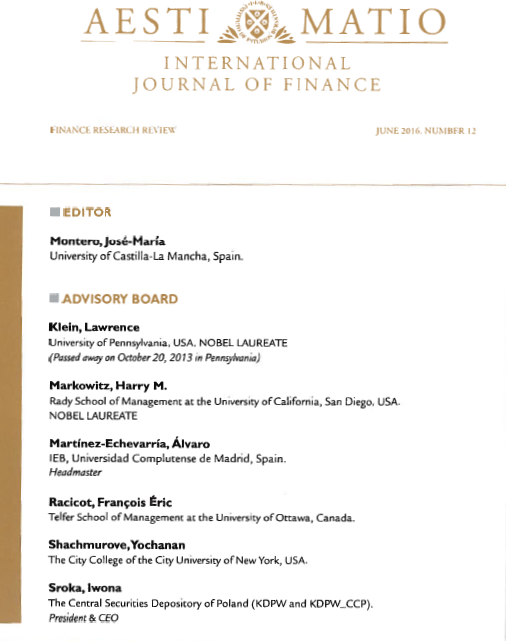 Francois Eric-Racicot, associate professor at the Telfer School, is on the advisory board of AESTIMATIO, the IEB International Journal of Finance (IEB is an acronym of the Madrid-based business school Instituto Estudios Bursátiles). The distinguished five-member advisory board includes academic leaders in finance including Harry Markowitz, Nobel Laureate in Economics.
Racicot is also on the editorial boards of the Journal of Asset Management (JAM), the Journal of Derivatives & Hedge Funds and the Review of Economics & Finance in addition to his work with the financial journal AESTIMATIO. A Telfer School faculty member since 2012, Professor Racicot is an accomplished researcher with numerous studies published in top peer-review journals and the author of several books in quantitative finance and financial econometrics used both by financial practitioners and universities, at the undergraduate and graduate level.
His most recent study is in the respected peer-reviewed journal Finance, published by the French Finance Association (“Asymmetrical Behavior of Hedge Funds Across the State of the Business Cycle: The Q-Factor Model Revisited”- October 2016).

Darlene Himick explores the activist turn of individual pension-plan members
Empowered by social media, individual investors who once had little say over corporate behavior today have influence through their membership in pension plans. The nature of this shift, though little studied to date, is now the focus of a new SSHRC-funded study led by the Telfer School’s Darlene Himick.
Professor Himick notes that there has been a rapid growth in Canadian funds and assets managed according to environmental, social and governance (ESG) factors in recent years. Over a similar period the Internet “has motivated individuals to act and changed the possibilities for them to organize as shareholders.” But how this engagement actually takes place is unclear, even as a number of important secondary questions remain unexplored, Himick notes. For example: do individuals accept the framing of issues (e.g., climate change) as risks in the way that institutional investors have? Do institutional and individual investors differ in thinking about risk?
Himick explains that institutional investors who have wanted to, for example, apply pressure for more climate-change disclosure from a company, have long had this ability, but the same cannot be said for individuals. “Only now do we see individuals on the verge of organizing around the specific intent to reconceptualize risks in order to effect environmental and social changes.
“By investigating how individual investors organize as activist shareholders, we begin to see them as actors who can access and use information to critically engage with the corporations in whom they have placed their future retirement monies.”

Researchers tackle OFC-involved bank risks
A new Telfer School study examining tax shelters and bank risk comes as business in Offshore Financial Centres, or OFCs, has quietly boomed.
“With global cooperation on OFCs at only an exploratory stage, the total amount of wealth managed in OFCs is soaring,” said accounting professor Tiemei Li, the principal investigator in the study, which in June received an Insight Development Grant from SSHRC. In 2014, OFCs accounted for 25 per cent, or almost $198 billion, of all direct Canadian investment abroad, three times the figure in the year 2000.
More and more financial companies have opened operations in OFCs as markets have continued to globalize. According to a recent report by the IMF, most of America’s largest banks maintain subsidiaries in OFCs while the Canadian ‘Big 5’ all established subsidiaries in OFCs.
“Given that presence, one might have expected a number of studies on the impact of bank operations in these jurisdictions on bank risk-taking, and the related economic consequences,” said Li, who worked in investment banking with one of China’s largest banks for nearly 10 years before turning to academia. “When we found that the research on those questions to date is actually very limited, we were quite surprised.”
Professor Li said a chief concern is the banks’ off-the-balance-sheet activities which are conducted under loose and flexible regulations and secrecy policies via OFC subsidiaries. “Lacking the outside scrutiny of regulators, auditors and shareholders on banks’ OFC subsidiaries, it is these undertakings that are most likely to increase bank risk-taking.”
Using a large archival sample of banks operating in OFCs from 1998 to 2014 together with a control sample, the team will develop empirical research models based on prior studies to create a fuller picture of OFC-involved bank risks. They will also examine in more detail the specific OFC features likely to significantly impact bank risk-taking and corporate fraud.
The outcomes will be of particular interest to regulators, helping them design rules concerning bank risk, noted professor Li. “Similarly, for government policymakers, our work will offer evidence for enhancing global cooperation and information transparency between OFCs and non-OFC countries and jurisdictions.”