Expert Perspectives on Teamwork in a Digital Economy
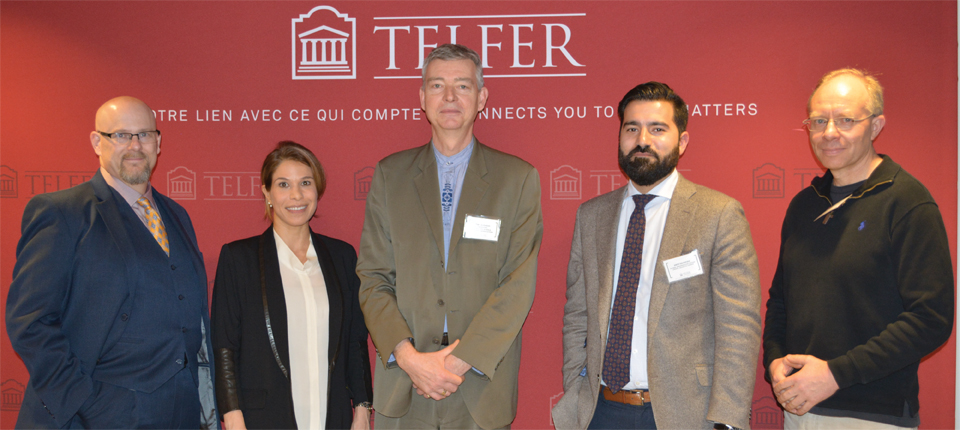
On April 6th 2017, the Telfer School of Management welcomed 50 participants for an event centered on the growing impact of teamwork in a digital economy. Composed of researchers drawn to teamwork, human resources experts and software developers keen on digital evolution, the panel shared their perspectives on working in a digital environment and how it affects employees, work, and people’s lives.
Randy Giffen, Healthcare Solution Architect from IBM Canada, started the conversation by describing his professional experience in digital tools development and their impact on virtual teams. Many of his projects involved virtual and remote teams’ collaboration. With more than 20 years of experience at IBM, he has been involved in a number of software projects including the Eclipse Project, Business Project Management and Predictive Maintenance and Quality.
Amir Rahnema, Global Organization Design Leader at Deloitte, examined the importance of organizational design. He explained that the organizational model adopted by most modern organizations dates back to ancient Rome. In the era of digital revolution, organizations need to be more adaptable to technology. Virtual teams are a good starting point since they represent a key element in organizational design and help organizations to stay competitive. However, to use virtual teams to their fullest, organizational design has to factor in their unique characteristics.
François Chiocchio, Associate Professor of Organizational Behaviour and Human Resources Management, Telfer School of Management, and Montfort Research Chair in the Organization of Health Services, spoke about his experience with digital teamwork in directing research projects. Digital economy has made remote projects not only possible but easier to realize. As an example, he noted that “webcam technology has enabled me to remotely manage a research project in Africa.”
Magda Donia, Assistant Professor of Organizational Behaviour at the Telfer School of Management, conducts research on the management of virtual teams, and her work shows that “traditional teams usually outperforms virtual teams.” Virtual interactions face several challenges, the biggest being cooperation and collaboration behaviours. Although virtual interactions hold many advantages, they cannot fully substitute face-to-face meetings, where relationships benefit from non-verbal communications and more subtle forms of interactions.
It is safe to say that technology has revolutionized our way of working. In a world where technology has become part of our daily routine, human interactions are still irreplaceable. Many opportunities and challenges are on the horizon for the future of organizations.

Small Business Operators Key to Sustainable Growth
The recent federal budget noted that innovation doesn’t only drive economic growth, it “can deliver a better quality of life: better health care; smarter, more connected cities; and cleaner, more sustainable energy, among many other examples”.
And that description is also a good definition of what socially-responsible small businesses do for Canada, according Professor Martine Spence of the Telfer School of Management
“Small and medium enterprises (SMEs) are moving the needle on sustainability, and the speed with which they adopt sustainable management practices has a lot to do with the will of entrepreneurs,” she observes. “SMEs have room to be innovative and nimble because it isn’t the shareholders calling the shots, it’s true entrepreneurs, proactive and risk-taking individuals, who can change course and adopt sustainable practices more easily than a large firm can.”
In her research, Professor Spence has taken a particular interest in how SMEs come to embrace a sustainable development approach. This includes examining the SME operators’ motivations, behaviours, and preferences with respect to public policies on small business. Her research usually takes her back, in one way or another, to the individual outlook of SME leaders – and the greater flexibility that SMEs appear to offer, when compared with large enterprises.
This is one reason why it was encouraging to see targeted programs for SMEs in the recent federal budget, especially the plan to provide up to $50 million to launch a new procurement program, Innovative Solutions Canada, modelled on the U.S. Small Business Innovation Research program.
Professor Spence contends that to build healthy economic growth and a more sustainable society, SMEs are exactly the right companies to focus on. “These firms are the backbone of the economy and they don’t hesitate to introduce green practices, whether that means favouring active transportation (walking and cycling), looking for ways to reduce their carbon footprint, or investing in less energy-intensive technologies.”
Much of this agility comes from having open-minded leaders, Spence suggests. “Peel back the entrepreneurial identity of one of these leaders, and you often find a citizen who is open to questions about sustainability, who makes a strong connection between sustainable practices and quality of life in their local community, who is in a good position to move their business down a path of social and environmental responsibility.”

Telfer School Welcomes Top Finance and Accounting Scholars with Experts from Bank of Canada and the International Monetary Fund
The Telfer Annual Conference on Accounting and Finance takes place on May 5 with a distinguished international roster of accounting and finance researchers.
As in previous years, that lineup includes leading experts from the world of policy and practice. In a session on banking and financial regulation, we will hear from a top research advisor at the Bank of Canada and an economist at the Federal Reserve Bank of New York. During the session on financial markets and international finance, we will hear from a senior economist at the IMF.
The accounting part of the conference will examine issues around analyst forecasting, financial accounting, corporate governance and corporate social responsibility. There will also be a presentation by Laurence Mussio, author of A Vision Greater Than Themselves, a history of the Bank of Montreal, on the occasion of BMO’s bicentennial.
Patricia O’Brien, Ernst & Young Professor of Accounting at the University of Waterloo and Campbell Harvey, the J. Paul Sticht Professor of Finance at Duke University will deliver keynote addresses. Professor O’Brien will focus on the role played by financial analysts as information intermediaries in times of regulatory change, while Professor Harvey will discuss issues around skill and luck and mutual funds and hedge funds.
The conference is co-chaired by Professors Lamia Chourou, Cheryl S. McWatters, Shantanu Dutta, and Samir Saadi, and it was made possible because of support received from the CPA-Canada Accounting and Governance Research Centre; the Telfer School of Management, the Father Edgar Thivierge Speaker Series; the University of Ottawa; Pearson; and Wiley.

Samir Saadi to Collaborate in an International Research Workshop on M&As
Professor Samir Saadi will represent the Telfer School on a team of top researchers examining merger-and-acquisition (M&A) practices at a Joint Israeli-Canadian Research Workshop. Interdisciplinary and inter-university, this workshop will focus on the necessary elements for the success of M&A in Canada and Israel at a moment when both nations are looking to derive more value from these and other forms of corporate reorganization. It will be funded by the Halbert Centre for Canadian Studies at the Hebrew University of Jerusalem.
Professor Saadi, an Associate Professor of Finance, brings a background in research on M&A activities in the high-tech industry and on the role of CEO power on M&As. With this project, his expertise will contribute to a better understanding of the potential barriers to successful transactions within the Canadian and Israeli contexts. This initiative comes at a time when firms from both countries frequently find themselves as targets, and therefore, improving the outcomes associated with these deals has consequences for business productivity, for employees, and for the potential adoption of new technologies or expertise.

Entrepreneurial drive begins at home
Family dynamics strongly influence a person’s desire to build and grow a new enterprise
What happens at home says a lot about a person’s potential to become the next Steve Jobs or the next Bill Gates. A closer look at family dynamics gives new perspectives on entrepreneurial behaviour, argues Peter Jaskiewicz, Full Professor of Entrepreneurship at the Telfer School of Management.
A person’s family background can explain why they might be more (or less) driven to create new ventures. For example, the family background might accustom someone to open dialogue, or make them comfortable with a wide variety of information sources. “And those attributes correlate nicely with the ability to recognize opportunities and lead a successful business venture,” Jaskiewicz suggests.
Families that avoid conflict or leave little room for open dialogue are worse off in this regard because these dynamics tend to foster respect of authority and conformity. That might set someone up to perform well in workplace settings where conformity of opinion is the norm, but it might make them less prone to start and lead a business.
Studies that look into family dynamics also help us to understand the outlook of entrepreneurs post start-up, Jaskiewicz says. We can gain a new perspective on entrepreneurial drive to grow and carry on a business over time, why some individuals lose that focus, and why others maintain it. This is also observed in how people interact and make decisions on boards of directors and on executive teams.
“Bringing the family dimension into entrepreneurship provides a different look at entrepreneurial behaviour, and a wealth of insights about the way to foster more entrepreneurship in society.”