Money, suspicion, and fraud: When client-bank relationship becomes a complicated affair
Financial scandals involving business moguls, well-known political figures, and even famous artists made the headlines in 2017. What is so alarming about the recent scandals, made public through the leaked Panama and Paradise Papers, is that they implicate several financial institutions, including a Canadian bank. Reportedly accepting their wealthy clients’ attempts to evade taxes and, in some cases, even encouraging them to set up offshore companies, some of the implicated banks later on simply claimed that they were not aware of their clients’ wrongdoings.
Although the leaked files expose illegal financial interactions between banks and wealthy individuals, any clients can actually commit fraud in their banking activities. If such fraud truly happens without the financial employees’ support or knowledge, how can banks detect their clients’ financial misconducts before they take the proportion of a public scandal or, worse, contribute to a financial crisis? Collecting and analyzing data from five banks in emerging economies for a research project entitled, “Can banks anticipate corporate misconduct”, Telfer School of Management Professor Lamia Chourou explains that, once a banking scandal goes public, our first reaction is to finger point at the banks’ clients. Professor Chourou and her team however believe that banks do play a major role in identifying their clients’ fraud upon suspicion and even reporting them if necessary.
Suppose a long-term client approaches a loan officer and provides a fake or outdated financial document. Having developed a very personal relationship with the client and looked over his/her investments for years, the officer senses something is unusual this time. Should the loan officer ask the client for additional information, talk to a supervisor, make the lending agreements tougher, or simply flag the client? Although these seem to be all very reasonable choices, in reality, client-bank relationships are far more complex than we think. Many bank employees may also lack the necessary support to make the “right” decision. According to Professor Chourou, we still know very little about how financial institutions operate when facing their clients’ fraudulent intentions. Therefore, it is hard to tell if and how banks handle such misconducts internally.
Understanding the role banks play in fraud identification, more generally, and their financial employees’ actions upon suspicion of their clients’ practices, more specifically, has enormous values. Professor Chourou’s insights will help banks improve their preventive regulations and better train their employees. Additionally, her research findings will help banks implement a more effective bank-client communication system, such brochures and newsletters, through which they can inform clients about the dangers of illegal financial activities.
If the 2008 crisis didn’t teach us anything about unethical financial decisions undermining the credibility of some of the largest financial institutions around the globe, making sure that banks carefully review their own clients’ suspicious activities will not only save their face but also benefit society.

Professor Peter Jaskiewicz: How to Raise an Entrepreneur
Professor Peter Jaskiewicz has recently published an op-ed in the Financial Post – Nature versus nurture: Is an entrepreneur born or raised? His article also informed an Ottawa Business Journal article, The ultimate guide to raising an entrepreneur. On Tuesday, December 5, 2017, CBC Ottawa Morning host Robyn Bresnahan interviewed Professor Jaskiewicz about his insights on how to raise future entrepreneurs.
Although there is no entrepreneurial gene, being raised in an entrepreneurial family matters quite a bit. If their parents are running a business, children inevitably form some entrepreneurial instincts. As role models, business owners thus have an impact on the entrepreneurial spirit of their children.
Research shows that successful entrepreneurs have two qualities: creativity and self-confidence. Parents who encourage children to participate in their businesses will foster their creativity and passion about the venture, but if parents are too strict, they could achieve the opposite. Other parenting styles also offer challenges: using a more laissez-faire approach may boost their kids’ creativity, but without discipline and structure, parents may fail to teach their children about the hard-working reality of the business world.
According to Professor Jaskiewicz, being demanding yet responsive is an important balance to help children flourish and keep the entrepreneurial spirit strong in the next generation.
Listen to Professor Jaskiewicz’s 8 minute CBC Radio Interview.

MSc student Jennifer Ho receives a Joseph-Armand Bombardier Canada Graduate Scholarship
Jennifer Ho has been awarded a Joseph-Armand Bombardier Canada Graduate Scholarship. This scholarship provides financial support to high-caliber students across Canada and enables them to fully concentrate on their studies.
Jennifer is in her second year of the M.Sc. in Management program at the Telfer School of Management. She obtained an Honours B.A. with specialization in Psychology and a Graduate Diploma in Program Evaluation in Psychology, both from the University of Ottawa. Wanting to learn from professor Silvia Bonaccio, an expert in the field of organizational behavior, Jennifer chose to pursue graduate studies at the Telfer School of Management.
Broadly, her research interests fall within the field of organizational behavior. Under the supervision of professor Bonaccio, her master’s thesis explores the facilitators and hindrances of job carving, a strategy that assists people with disabilities in finding and maintaining meaningful employment, from the perspective of employment specialists and employers. She is also interested in examining workplace discrimination, occupational stress, and employee well-being.

Boushra El Haj Hassan, Joseph-Armand Bombardier Canada Graduate Scholarship recipient
Boushra El Haj Hassan has been awarded a Joseph-Armand Bombardier Canada Graduate Scholarship. This scholarship provides financial support to high-caliber students across Canada and enables them to fully concentrate on their studies.
Boushra is a PhD student in Management, in the field of Finance. She holds a Master of Science in Management (2011), and a Bachelor of Commerce (2008), from the University of Ottawa and graduated with the highest honor – Summa Cum Laude. At the professional level, she has 10 years of experience in the public sector. Her professional profile includes a work term at Cognos incorporated as a Customer Support Technical Analyst, and many assignments at the University of Ottawa as a Teacher Assistant.
Boushra’s research interests include behavioral finance and corporate governance. For her thesis, the research will be focused on firms’ political connections and executive compensation. She chose the Telfer School of Management because of the supportive environment necessary to succeed and develop at the PhD level: great professors, great support from the graduate office and the research office staffs.
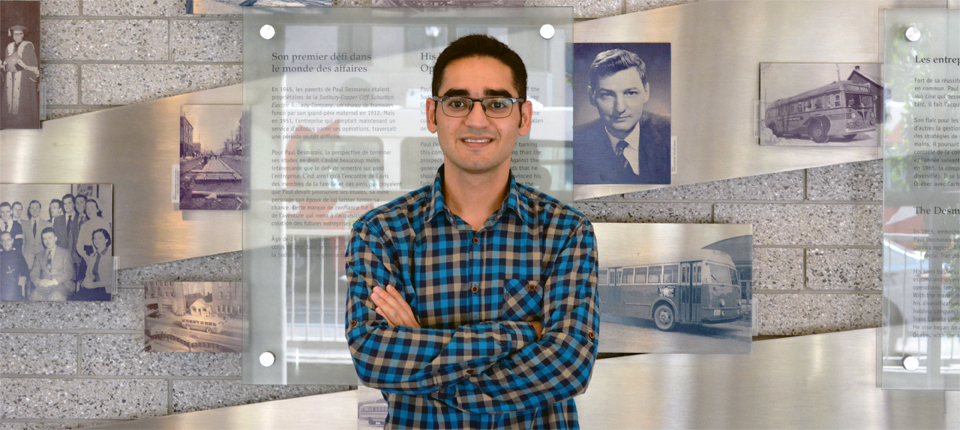
Afshin Kamyabniya, PhD student recently awarded the Trillium Ontario Scholarship
Afshin Kamyabniya is currently pursuing his PhD studies in Management with a focus on Health Systems specialization under the supervision of Professor Jonathan Patrick. By joining the research team of Professor Patrick, Afshin wishes to focus on operations management and its applications in the context of healthcare operations research, logistics, disaster relief operations, blood supply chain, and multi-organizational coordination modeling domains.
Before arriving at the Telfer School of Management, Afshin graduated from IRAN University of Science and Technology in the field of Industrial Engineering with honors and distinction. Upon completion of his master's studies in 2015, he was granted a research scholarship from Ministry of Science, Research, and Technology of Iran to work as a researcher at Purdue University, Indiana, USA. Also, he has worked for 5 years in Iran in different capacities in the field of logistics and supply chain network design for the telecommunication industry and for disaster relief organizations.
Since Afshin’s arrival at Telfer, he was nominated and won the Ontario Trillium Scholarship. He is passionately devoted to his doctorate studies by exploring new areas of research and aims to progress steadily towards valuable contributions.