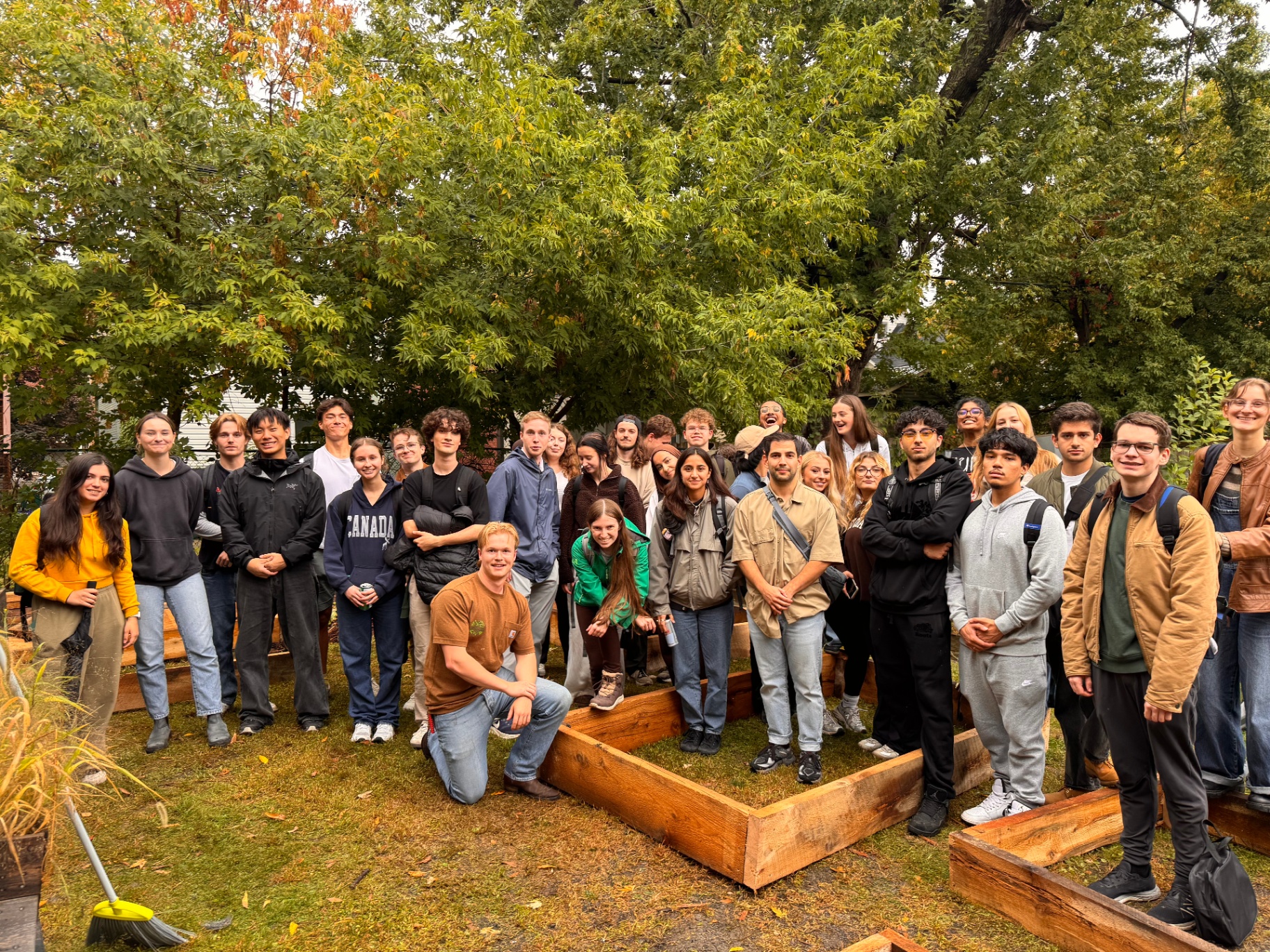
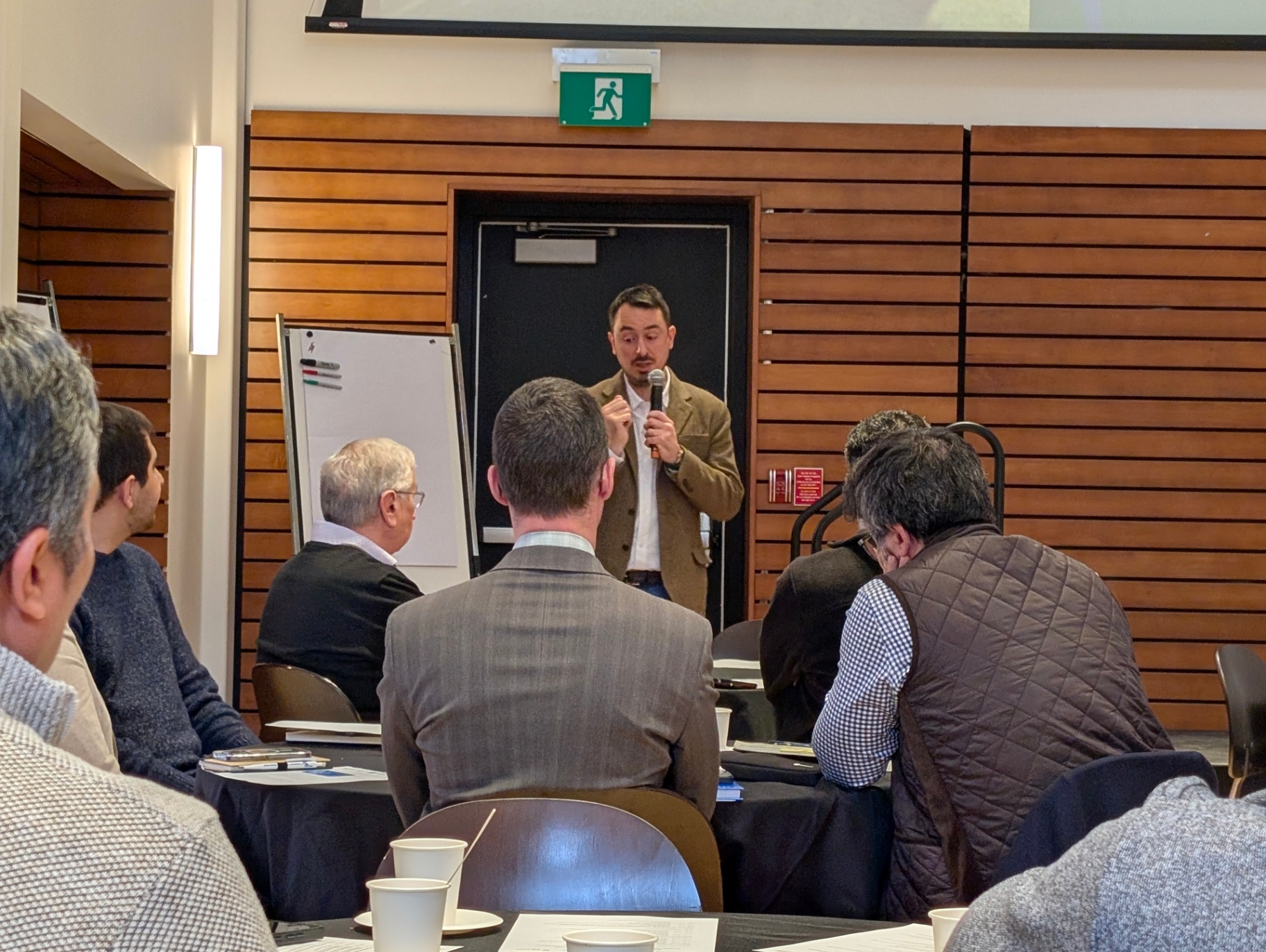
There are moments in a year when a campus feels different. Not louder, not busier, but more alive. March was one of those moments this year. For the first time, the Sustainable Development Solutions Network (SDSN) expanded SDG Week into a full SDG Month across Canadian colleges and universities. At the University of Ottawa, that shift translated into over 30 events, workshops, and experiences.
It took four months to build. It took hundreds of hands to carry. And in the end, it brought together over 1,000 participants, 2,000+ campus engagements, and a growing digital community of 73,000+ views through @TelferSustainability in just 30 days.
This year also marked the launch of SDG Month LinkedIn badge certificates, recognizing student engagement not just through attendance, but through action. More than 300+ students received a Participation Certificate. 40+ students were recognized as Sustainability Leaders. And 12+ students emerged as SDG Changemakers, going beyond participation to fully engage with the experience.
But numbers don’t tell the full story. What happened this March was something else entirely.
Seeing the World, with a pinch of art
Throughout the month, students walked into the WUSC’s Through My Eyes art exhibition at the Jock Turcot Student Lounge. They saw the world through lived experiences of artists from Canada, Ghana and Malawi, stories of displacement, resilience, identity, and hope.
Across all 17 Sustainable Development Goals, the exhibition invited something rare in a university setting: to slow down, to feel, and to sit with complexity. And that tone - reflective, human, grounded - carried into everything that followed.
Rethinking Work, Purpose, and the Future
On March 11, more than 100 students joined a live online conversation on green careers with Mike Gerbis, moderated by Carla de Ciccio. Gerbis, former Founder and CEO of the Delphi Group and now an executive coach with The Executive Committee (TEC Canada), brought over 30 years of experience in sustainability consulting and leadership development. But more importantly, he brought candour.
What does it actually mean to build a career in sustainability? What skills matter? What trade-offs exist? What does resilience look like in uncertain times?
Carla de Ciccio, a Telfer alumna and Marketing Director at Growcer, anchored the discussion in lived experience bridging the gap between classroom learning and industry realities. Her perspective brought the conversation closer to home, offering students a clear and relatable view of what sustainability careers can look like in practice. Watch the webinar here.
A Campus Turned Into a Living Lab
By mid-March, the Desmarais halls didn’t just host students rushing between classes, they became a space people chose to stop in. To linger. To engage. Kiosks lined the corridors, but what stood out wasn’t the setup, it was the energy. Students gathered around SDG cubes, paused for conversations, challenged each other, asked questions they hadn’t considered before. The Sustainable Development Goals, often seen as distant or abstract, became something else entirely: tangible and grounded in everyday choices.
Across campus, the Entrepreneurship Hub launched its Sustainability Treasure Hunt, a week-long, interactive challenge that invited students to explore the SDGs through their own environment. Part curiosity, part discovery, part reflection, it turned the campus itself into a map of hidden systems, overlooked spaces, and new ways of seeing.
At the Government of Canada SDG booth, led by representatives from Employment and Social Development Canada, those conversations deepened. Students moved from curiosity to understanding connecting global policy frameworks like the 2030 Agenda to real initiatives shaping communities across Canada.
And then came the competitions.
Learning by Doing (and Giving Back)
Five challenge-based workshops invited students to tackle real-world sustainability issues from transportation policy to circular design. But this year, winning meant more. Each winning team received a cash prize, matched by a donation to a charity of their choice. Because impact, here, was never meant to stop at the classroom. Win together. Give back together.
Imagining What Doesn’t Exist Yet
On Imagine Day, March 16th, Professor Mathieu Bouchard asked students a simple question: What if mobility looked different? What followed was practical, ambitious, and grounded in systems thinking. Students moved beyond individual behaviors to consider infrastructure, access and community, seeing transportation not as a fixed system, but as something we can actively reshape.
Among the ideas that emerged, one stood out winning the competition: The Ottawa Bike Library a community-driven hub for bike rentals, repairs, workshops, and local partnerships. More than a service, it proposed a shift in how people access and relate to mobility, making cycling more inclusive, more accessible, and more embedded in everyday life.
For Hadeel Youssef, a member of the winning team, the experience went beyond the idea itself: “As students, we have a powerful voice and powerful ideas and an event like this may not look like much, but conversations and experiences like this give us the confidence, knowledge, and connections to actually do something about it.”
It wasn’t just a strong concept. It was a glimpse of what becomes possible when students realize their ideas don’t just belong in the classroom, they can shape the world beyond it.
On Rethink Day, March 17th, students stepped into one of the most complex transitions of our time: the electrification of Canada’s transportation system. The session opened with remarks from Telfer Dean Stéphane Brutus, whose presence set the tone with warmth and intention.
Guided by the Electric Vehicle Council of Ottawa CEO, Raymond Leury and Telfer Professor Sharon O'Sullivan, students were challenged to do what policymakers and industry leaders are still grappling with: design a set of coherent public policies that could accelerate EV adoption while protecting Canadian jobs and strengthening domestic supply chains.
They had to think across systems, manufacturing, critical minerals, charging infrastructure, consumer incentives, trade, workforce transition, accessibility.
And they did.
Among the teams, one stood out for its ability to embrace that complexity rather than reduce it. Group 11’s Justin Lazare, Tony Villiatchko, Shanvir Betchoo, Shuao Su, Nudish Radhoa, Jimmy Côté, Jacob Boyer, and Felix cuillerier Charbonneau developed a proposal that balanced ambition with economic realism, addressing supply constraints while pushing Canada forward.
What made the experience powerful wasn’t just the outcome it was the exchange between those shaping the future and those about to inherit it.
“This is exactly why these spaces matter,” Leury shared. “When you bring students into these conversations, you’re not just teaching them, you’re learning alongside them, as part of the same community. Some of these ideas deserve to go further, and many of them will. I fully intend to bring them into real policy conversations.”
For Professor O’Sullivan, the session reflected something deeper about the role of education today: “We have a responsibility to create learning environments that help students navigate complexity, question what they hear, and build the confidence to form their own informed perspectives. That’s how you move from awareness to action.”
On March 18, Create Day transformed SDG Month into something tangible. In partnership with the Upcycling Club, students gathered for a hands-on workshop: Build Your Own Birdhouse. What we expected to be a well-attended session quickly became something else entirely. The room was packed. Not just full, but overflowing. One of the largest spaces on campus, The Huguette Labelle room in Tabaret, filled with students ready to try something many of them had never done before.
Hammers. Screws. Reclaimed wood. At first, you could feel the hesitation. “Wait… we’re actually cutting this?” , or the “I’ve never used tools before…”
There were unsure glances. Nervous laughter. A quiet question in the air: can I actually do this? And then, slowly but surely, something shifted. Hands steadied. Conversations sparked. Strangers became teammates. What started as uncertainty turned into focus, then into confidence. Students weren’t just following instructions anymore.
They were building. Creating. Figuring it out. Birdhouses began to take shape, each one different, each one imperfect, each one real.
Pieces of wood once destined for waste were transformed into something meaningful, through effort, collaboration, and a willingness to try.
Halfway through, you could hear it: “Wait… I’m actually good at this.” What unfolded in that room was more than a workshop. It was circularity, it was in their hands. It was experiential learning at its most honest. It was students stepping out of their comfort zones and realizing they could do more than they thought.
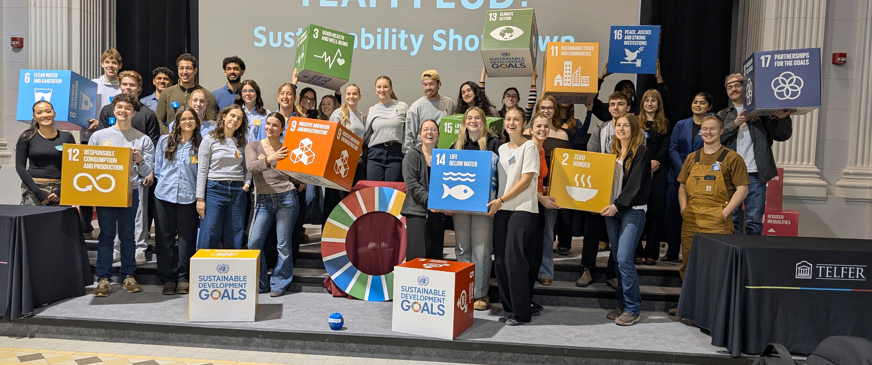
Later that same day, on March 18, the energy didn’t slow down, it multiplied. In partnership with the Telfer Competitions Committee (TCCT), SDG Month took a different turn. One that no one quite expected. Zero Waste Team Feud: Sustainability Showdown.
Inspired by the classic Family Feud game format, but reimagined through a sustainability lens, the competition brought together 17 teams, each representing one of the 17 Sustainable Development Goals. And the room? Packed. Students standing along the walls, sitting on the floor, leaning in just to catch a glimpse. The kind of energy you don’t script.
We kicked things off with a keynote from Angela Plant, from the city of Ottawa, who grounded the moment in real-world impact, sharing how zero waste initiatives are shaping the city. And then, Game time.
Buzzers. Laughter. Last-minute steals. Teams catching up out of nowhere. Every round shifting the momentum. Students were learning, without realizing it.
Debating habits. Challenging assumptions. Discovering what zero waste actually looks like in practice, not theory.
In the end, the team representing Life on Land (SDG 15) emerged as the winner, directing their matched donation to Équiterre. But by that point, it almost didn’t matter who won. Because something else had already landed. Sustainability felt engaging and even dare we say FUN.
And in a room where people stayed long after they found a seat, just to be part of it, that might be one of the most powerful outcomes of all.
On March 19, Gather Day shifted the focus once again away from structured sessions and into the everyday spaces students move through without a second thought. But that day, those spaces told a different story. In the Desmarais lobby, the Free Store pop-up by the Office of Campus Sustainability drew a steady, uninterrupted flow of students. Tables filled with clothing, books, everyday items circulating from one person to another. What might have been discarded found new use, new value, new life. A quiet but powerful demonstration that circularity doesn’t always require innovation; it often starts with redistribution, with care, with community.
At the same time, across campus, students stepped into another experience. Led by Jonathan Rausseo and the Office of Campus Sustainability, the Zero Waste Campus Tour offered something rarely seen: a behind-the-scenes look at what happens after we throw something away. Waste streams. Sorting systems. Operational decisions. The infrastructure that quietly sustains, or fails, our sustainability efforts. What is usually invisible became visible. And with that visibility came something else: accountability.
Students began to connect their everyday actions to larger systems, to understand that waste isn’t just an individual issue, but a shared, structural one.
From the Entrepreneurship Hub: Sustainability in the Everyday
Jerusha Tan, the winning participant of the Treasure Hunt, didn’t start with a large-scale system. She started with something small. Almost invisible. A neglected magazine rack at Dominion Station. But what she uncovered wasn’t just about infrastructure, it was about normalization.
“Its presence, although unnoticed in the bustling city, marks a disturbing inaction… It’s as if we ignore the negligence because we’re led to believe it is the norm.”
Through the challenge, what seemed ordinary became a question. Is this what public space is supposed to feel like? And if not, why have we accepted it? Her reflection didn’t propose a complex solution. It did something more important. It made the invisible visible. It reminded us that sustainability doesn’t always begin with innovation. Sometimes, it begins with discomfort. With noticing. With refusing to accept what no longer makes sense.
By March 20, more than 500 students, faculty, partners, and community members gathered in Desmarais for the Closing Celebration. A pause to recognize what had happened over the past weeks, what had shifted. We even had music. Student cellists Elisheva Schwartz and Kelly Cooper from the School of Music filled the space with a performance that moved between old and contemporary pieces, hopeful, reflective, and deeply felt. For a moment, everything slowed down. Conversations paused. People listened.
Daina Mazutis, Telfer Professor, Director of sustainability at Telfer, Co-Lead of the Centre for Sustainable Impact (CSIID) and Director of The Green Academy, acknowledged what had been built. Ideas that became prototypes. Students who stepped out of their comfort zones. Teams that formed across faculties, disciplines, and perspectives, and left changed by it. This was not just about outcomes. It was about transformation.
Geselbracht didn’t offer easy answers. Instead, he shared stories, real, grounded, sometimes difficult, of climate action unfolding across communities. Stories that didn’t ignore the weight of the moment but refused to stop there. Because even in a time of climate anxiety, he reminded us, stories of action still matter.
And then, rather than ending there, the day did something even more powerful. It opened into the next chapter. Because March 20 was not only our Closing Celebration. It was also the kickoff of the SDG Month Innovation Sprint, an immersive weekend experience centered on SDG 12: Responsible Consumption and Production. If the month had invited students to question systems, this was where they began actively redesigning them. The sprint began with a panel expertly moderated by Emma Segal, Academic Lead of the Innovation Sprint, which brought students face to face with people working across design, circular economy, sustainability, and systems change. Valérie Leloup, Strategic Lead for Waste and the Circular Economy at EnviroCentre, Founder and CEO of Nu Grocer, brought deep expertise in waste reduction, diversion, and circular practices. Caitlin Perry, Telfer alumna, sustainability and communications professional, and member of the Circular Innovation Council, shared how education, communication, and stakeholder engagement can help organizations and communities rethink resource use. Kwaku Kusi-Appiah, human geographer and doctoral candidate in the Department of Geography and Environmental Studies, brought a lens rooted in political ecology, water access, and global inequities. And Carleton Professor Chantal Trudel, whose work spans industrial design, architecture, and healthcare environments, added a design perspective shaped by years of interdisciplinary practice.
Together, they showed that sustainability work is design. It is infrastructure. It is justice. It is policy. It is systems. It is the built environment. It is what we throw away, what we keep, what we normalize, and what we dare to redesign. That conversation set the tone for the days that followed.
Over the course of the sprint weekend, students performed what could only be described as autopsies on everyday products. They didn’t just think about products, they opened them up, literally and metaphorically. They examined materials, systems, behaviors, and assumptions. They were asked to explore how products and services might be designed not simply to reduce harm at end-of-life, but to prevent waste and pollution from the beginning, while building in value, regeneration, and responsibility from the start. And of the ideas that emerged, two stood out.
The Another Step team, Kenza Habbak, Sara Soulati, Puneet Perhar, Sara Yao, and Hawa Souleyman, proposed a community-based cobbler model that reimagines repair culture. Their concept focused not only on reducing waste, but on preserving skills, rebuilding local connection, and restoring value to what we often discard.
The Loop Denim team, Josh Bowry and Nikita Irakize, captured the People’s Choice Award with a proposal to rethink denim through lifecycle design, integrating circular materials and digital product passports to extend use and reduce environmental impact.
And for the winning teams, they won’t stop here, both projects received seed funding to continue developing their concepts through self-directed courses.
What We Built, Together
SDG Month 2026 was never one team’s effort. It was shaped by faculty, partners, mentors, and collaborators across disciplines and institutions. From professors like Éric Nelson, Mathieu Bouchard, and Sharon O'Sullivan, who brought experiential learning into their courses, to partners across government, industry, and community organizations, this month became what it was because people chose to build it together.
But what stayed with me most were the students. One example of this would be when I met Karine Brault at the beginning of the month. She told me she didn’t really know what the Sustainable Development Goals were and she wasn’t sure what to expect. Like many students, she came in curious, but unsure of where she fit in all of it. And then she stayed. She showed up to workshops. She asked questions. She stepped into spaces that were unfamiliar. She even ended up signing up, last minute, for the Innovation Sprint on SDG 12.
By the end of the month, something had shifted. She wasn’t just participating anymore. She was thinking differently. Speaking differently. Seeing systems where before there were just everyday things. She even became one of SDG Month’s Sustainability Leaders. And her story stayed with me, not because it was exceptional, but because it wasn’t. It was one of many. And that’s the point.
None of this happens without access. Without professors who open their classrooms. Without spaces that invite students to step in before they feel ready. And none of it, truly, would have been possible without the 17 student volunteers behind the scenes. They were the ones holding the flow. Guiding students. Answering questions. Managing rooms, transitions, energy often without pause. Always with care.
Looking Ahead
Next year marks five years of SDG Month at uOttawa. A milestone, but also a moment to ask what more is possible. We’re already laying the groundwork: simpler, more meaningful ways to recognize engagement, new experiences like an SDG Passport, and expanded opportunities for students to step in across campus, across disciplines, and beyond university walls. The momentum is there, what comes next is ours to build.
But it’s hard to write about what’s ahead without acknowledging the world beyond campus. And if you’ve stayed with me this far, thank you, this has been a longer story than most. Some moments are harder to write about than others, and this was one of them.
So before I close, I’ll allow a more personal note from yours truly. For many of us, this past year has been heavy. Personally, as someone from many parts of the world with a multicultural identity, with family still living through conflict, the weight of global events is not abstract; it’s immediate. And at times, it makes the future feel uncertain. And yet, this month reminded me that while narratives of division, fear, and regression may be loud, they are not the only ones being written. In classrooms, in workshops, in conversations between students who had never met before, from diverse backgrounds and walks of life, another story was unfolding.
One of collaboration and action. For a moment, we didn’t just talk about the future we wanted. We practiced it. And that, perhaps, is the most important thing SDG Month gave us this year, not just the awareness but something we seem to need now more than ever.
Hope
So to every student who showed up. Every professor who opened their classroom. Every partner, speaker, and collaborator who gave their time. very staff member and every volunteer who carried this month forward, Thank you.
Thank you for giving me, and each other, what is needed most right now. At a time when so many forces are trying to extinguish it: Hope we can build.
This article was written by Takwa Youssef, coordinator of Telfer's Green Academy.
As coordinator of the Green Academy, Takwa plays a key role in supporting the delivery of the academy's interdisciplinary programs. She oversees logistics, event coordination, and resource management, ensuring the successful execution of courses, workshops, training, and research. Takwa bridges faculties, services, and external partners, cultivating collaboration that enriches the program’s impact. She manages communication, finances and administration, while also driving the Academy’s long-term vision by strengthening connections across disciplines and supporting its ongoing growth.


.jpg)