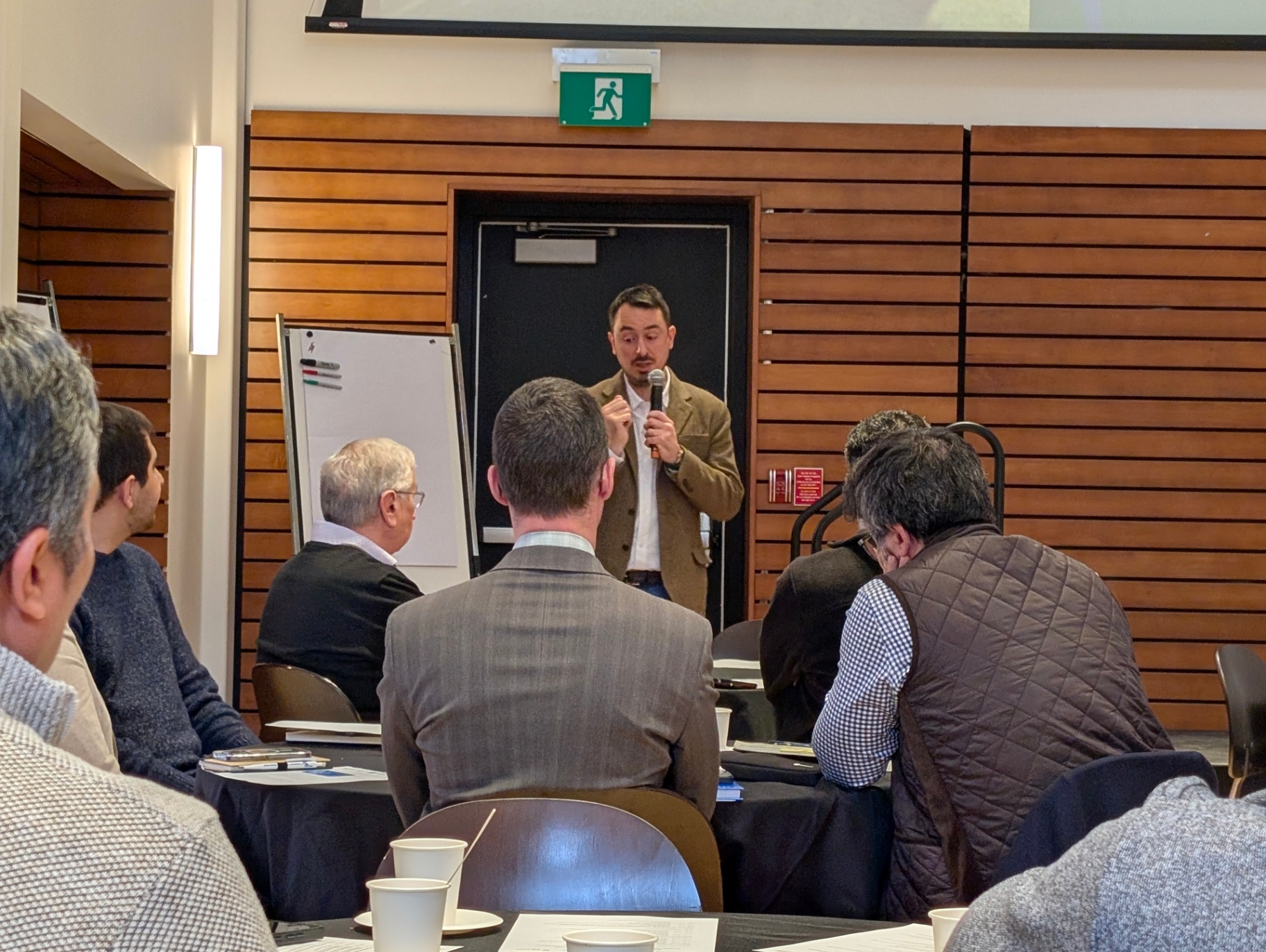
There was a sense of purpose in the room at the Alex Trebek belairdirect Hall as academics, industry leaders, and public sector partners gathered to reflect on an emerging reality: the world of international trade is shifting, and both Canada and Latin America are standing at a crossroads. The workshop, led and facilitated by Telfer Professor Tommaso Ferretti, explored how sustainability and global value chain diversification can become shared engines of resilience at a moment when traditional economic anchors feel increasingly unstable.
What framed the conversation was the idea of the “global disorder” a term used to capture the volatility created by tariff shocks, geopolitical fractures, and a rebalancing of economic power. For Canadian companies historically tied to the United States, this uncertainty is no longer theoretical.
As Professor Tommaso Ferretti observed, “relationships that held for decades can now shift in a single policy cycle.” And yet, within this disruption lies possibility.

A recurring theme surfaced early: Latin America is no longer a distant alternative, but a strategic partner. Samantha Khoury from Invest in Canada noted a marked rise in investment interest from Brazil, Mexico, and Chile and pointed out that sustainability incentives and stable regulatory environments have become magnets.
She reminded the room that while the United States has generated uncertainty, it has also “opened doors that were previously overlooked.” Her insight underscored a subtle but decisive shift: diversification is not an act of risk, but of prudence.

The conversation widened with the perspective of Professor Keysa Mascena from the University of Fortaleza, who offered a compelling example of how renewable energy ecosystems evolve when rooted in community reality. She spoke of Ceará’s transformation from a region defined by water scarcity to a hub for wind, solar, and now green hydrogen investment, with more than thirty national and international firms exploring partnerships.
What resonated most was her reminder that innovation must be inclusive: “Actors can be blind to the communities around the value chain,” she said, urging reflection on energy justice, social impact assessments, and shared responsibility.
Her account of the Palma Solar initiative where residents financed and managed a photovoltaic plant for local production and consumption illustrated what it means for sustainability to be lived rather than branded.

A complementary perspective came from Francisco Appelgren of InvestChile,
who illustrated how long-term policy consistency can accelerate green industrial capacity. Chile’s national lithium strategy, its extensive network of trade agreements, and its clear targets for renewable energy adoption offered a contrast that prompted reflection in the room. His remarks highlighted that while regulatory stringency can sometimes slow permits, strong institutions and a stable vision, anchored in decarbonization and export orientation, can position a country as a dependable partner to reach the technological frontier in the emerging green economy. The comparison invited an implicit question: how might Canada mirror that clarity while shaping its own diversification pathway?

From there, the dialogue turned toward the practical challenges of turning potential into practice. Zachary Chrumka from Export Development Canada highlighted the role of financing models that allow companies to enter new markets without absorbing prohibitive risk, while pointing to the billions already deployed to support clean technology growth. But de-risking via financing and guarantees is not the only enabling factor of green trade. Mr. Chrumka also underlined the fundamental role of government support institutions in “identifying foreign companies that are the most promising to become global platforms for the development of new supply chains and market opportunities” linked to green, such as bio alternatives to plastic or bio fuels. It takes a long, evidence-based process to select high-potential partners with technological complementarities that are of interest to Canadian companies and business ecosystems. The key takeaway was clear: capacity for linking Canadian growth to green value chains exists, but it must be better aligned with firms seeking to scale internationally and enabling services.

An additional thread emerged through the lens of commercialization and business culture as they relate to green technology adoption and market development. Andrea Gardella of Alcance Solutions and the Brazil-Canada Chamber of Commerce, reflected on the enthusiasm of Brazilian small and medium enterprises (SMEs) seeking entry into Canada as well as Canadian SMEs exploring opportunities in Latin America but noted that success requires more than technology. It requires fluency in legal, cultural, and relational skills and the ability to integrate expertise gaps that are a natural in SMEs, due to their size and limited resources She emphasized that due to those reasons, Canada often i struggles to bring to market the technological solutions it excels at developing. Andrea suggested that policies may need to encourage early-stage cross-border adoption and stimulate more ties and collaborations across different stakeholders and support institutions within Canadian business ecosystems.
Her remark lingered: “You don’t always need new incentives, sometimes you just need simpler ones.”
It was then the time of Ken Bradley, who shares his insights as the Chairman and Chief Strategy Officer of Lytica. As a company enabling efficiency and profitability in electronic components’ global value chains through spend analytics and risk intelligence powered by real customer data, Ken highlighted the increase pace and data-driven nature of product design, supplier selection, and technology adoption, which makes it harder for businesses to maintain a competitive hedge over larger corporations and quick-adopters of new tech. These trends have implications for how we think about sustainability in global business. On the one hand, it is more and more important to “get sustainability integrated already at the architecture design stage”; on the other, the needs to constantly reconfigure the supply chain and face increasing due diligence requirements poses a challenge from the sustainability measurement perspective. Ken suggestes that focusing on innovation and building trust with your counterparts and their stakeholders is an important recipe to overcome those challenges.
Finally, Arianna Bondi, PhD Candidate in Political Science at McGill University, illustrated a research project that promises to generate evidence to inform substantial answers to some of the challenges emerged in previous conversations. The project builds on Arianna’s exceptional methodological expertise and global value chains know-how and leverage an international research team that includes Prof. Ferretti (Telfer), Prof. Mascena (University of Fortaleza), Prof. Maria-Jose; Murcia (IAE Buenos Aires), and Prof. Thomaz Novais Rocha (Instituto de Éticas Aplicadas - Pontificia Universidad Católica de Chile). Arianna observed that companies across industries and geographies in Latin American and Canada must navigate concurrent profitability pressures and sustainability goals. The new “global disorder’ is now adding severe geopolitical disruptions to the mix. How do geopolitical shocks such as the US tariffs impact the way exporters balance their commitment to profit vs sustainability? The firm survey that the research team is about to conduct in Argentina, Brazil, Chile, and Canada will develop a clear answer to this question.

What made the workshop meaningful was not a single conclusion, but the convergence of perspectives. There was recognition that trade diversification, sustainability, and innovation are no longer parallel conversations, but intertwined ones. There was acknowledgement that community impact must have a seat at the table. And there was a shared understanding that collaboration between academia, government, and industry is necessary. Professor Ferretti closed the event by returning to the bigger picture. If old assumptions about global trade are dissolving, then there is an opening to rethink how economies connect, how industries evolve, and how environmental responsibility can become a competitive strength rather than a regulatory burden. The conversations that unfolded were not the end of something, but the beginning of a longer dialogue one that will continue to shape research partnerships, student engagement, and future exchanges between Canada and Latin America.
In a moment when the world feels fragmented, this workshop offered a reminder that bridges can still be built, and that sustainability may be one of the strongest foundations on which to build them.
We extend our thanks to all those who joined the conversation and contributed their perspectives, with particular appreciation to Samantha Khoury (Invest in Canada), Professor Keysa Mascena (University of Fortaleza), Zachary Chrumka (Export Development Canada), Andrea Gardella (Alcance Solutions; Brazil-Canada Chamber of Commerce), Ken Bradley (Lytica Inc.), and Arianna Bondi (McGill University), whose reflections helped shape a rich and forward-looking exchange. And of course, warm recognition to Professor Tommaso Ferretti (Telfer School of Management) for convening and guiding this important dialogue, and to all attendees whose engagement made the workshop both meaningful and memorable.


This article was written by Takwa Youssef, coordinator of Telfer's Green Academy.
As coordinator of the Green Academy, Takwa plays a key role in supporting the delivery of the academy's interdisciplinary programs. She oversees logistics, event coordination, and resource management, ensuring the successful execution of courses, workshops, training, and research. Takwa bridges faculties, services, and external partners, cultivating collaboration that enriches the program’s impact. She manages communication, finances and administration, while also driving the Academy’s long-term vision by strengthening connections across disciplines and

.jpg)