Inside the Green Academy’s Innovation Sprint on Responsible Consumption & Production (SDG 12)
In a world that now often feels defined by fracture of systems, of trust, of shared futures, there are still spaces where people are choosing not to give in to that reality, but to keep building, imagining, and pushing for change.
At the end of SDG Month in March 2026, something shifted inside Desmarais. Classrooms gave way to a different kind of learning, one that asked less about what students knew, and more about what they were willing to question, take apart, and rebuild.
The Green Academy’s Innovation Sprint on Sustainable Production & Consumption (SDG 12) focused on the systems behind everyday life, how products are made, used, and discarded, and what it might look like to design them differently.
Where It Began: Rethinking “Circularity”
The Sprint opened on the afternoon of March 20th in the Camille Villeneuve Room.

An indigenous affirmation by Greg Meekis of the Odawa Native Friendship Centre set the tone as an invitation. To remember that design did not begin with us.

That regenerative systems, circular thinking, and respect for materials have long existed organically in nature and its systems. That sustainability is not an innovation; it is a return.
The session opened with remarks from Professor Daina Mazutis, Director of Sustainability and the Green Academy at Telfer, grounding the conversation and setting the tone for what was to come.
From there, the panel led by academic lead Emma Segal, a thoughtful and deeply grounded sustainability designer and educator with over two decades of experience translating complex systems into practical, real-world solutions across industry, government, and global organizations, challenged one of the most persistent misconceptions students carry into sustainability work: that circularity is simply about recycling. It is not. As surfaced throughout the discussion, circularity asks something much deeper: to move from waste management to systems redesign, to design not just products, but the conditions around them from behavior to infrastructure, policy and culture.
“Everyone is a designer,” She tells us. Every choice, what we buy, how we use, what we discard is participation in a system. And systems, unlike objects, do not change easily.
Panelists Valérie Leloup (EnviroCentre and Founder of NuGrocery), Caitlin Perry (Circular Innovation Council), Kwaku Kusi-Appiah (human geographer and educator), and Chantal Trudel (designer and interdisciplinary practitioner/educator) spoke candidly about the realities and opportunities of sustainable design, not as a set of ideals, but as a practice of thoughtful and considered decision-making within real-world constraints.
They unpacked what happens when a product that appears sustainable in isolation meets the real world, where infrastructure is imperfect, systems are fragmented, and human behavior doesn’t always follow intention. Convenience, cost, and habit, they emphasized, often outweigh even the best-intentioned solutions.

Valérie Leloup shared stories from her work in waste reduction and packaging systems that revealed just how quickly “simple” zero-waste ideas become complex in practice. In one example, she described efforts to eliminate packaging entirely, only to run into unexpected challenges around food safety, transport, and user habits. What sounds like a perfect solution on paper, she noted with a smile, can unravel the moment it meets real people in real contexts, where logistics, safety, and user behavior reshape what is actually possible.
Kwaku Kusi-Appiah grounded the conversation in something more personal. Holding shea butter sourced through his own community, he spoke about his grandmother, about knowledge passed down through generations, and about materials that exist within systems of care, culture, and reuse long before they are ever commodified. The object itself became a quiet reminder: not everything needs to be redesigned or packaged to have value. Some systems already work, if we choose to pay attention.
Chantal Trudel pushed the room further, noting that the hardest challenge is often not the product, but the behavior and mindsets around it. Designing for sustainability, she suggested, means designing for people, their habits, their resistance, their realities.
Across the conversation, one idea lingered: A perfect solution that no one uses is not a solution.
The Sorting Hat and the Product Autopsies
If the first day asked students to think differently, the second asked them to experience it. It began, unexpectedly, with a sorting hat, in a moment that felt almost like a scene out of Harry Potter. One by one, teams sent a representative forward to draw a number. Each number corresponded to a sealed box waiting at the front of the room. Inside: an everyday object was revealed. Ordinary. Familiar. Suddenly, theirs.
There was laughter at first, curiosity, a bit of suspense, some nervous glances. And then, as boxes opened, a shift. Whatever they had drawn, they would have to live with it. Take it apart. Understand it. Question it. And then, redesign it.
Watch highlights from the sorting hat moment
Minutes later, the Telfer Library transformed.

What is usually a quiet, contemplative space became alive with the sound of tools, tearing materials, questions spoken out loud. Students began what could only be described as product autopsies. They dissected. They mapped. They asked: Why was this made this way in the first place? Guiding and supporting them in this process was Maximillian Benda, founder of the Upcycling Club and an Innovation Sprint alumnus himself, bringing both technical insight and lived experience to the room.

One team discovered a fan sealed completely shut, designed not to be repaired, but replaced. A perfect metaphor for systems built now on disposability. Around them, community mentors representing multiple aspects of product design (textiles, chemicals, social impact, waste, scientific research, engineering, and climate policy etc) moved from table to table, asking thought provoking questions.
Watch the highlights from the product autopsies.
I spoke to some of the mentors and they each shared with me what this experience meant to them.
Kwaku Kusi-Appiah told me “I’ve always been interestecircularity, how can you not be?”. Everything on earth and about us is circular. We come to life, and we go back to the earth. Consumption is circular. How long can we consume if we don’t have good sustainable practices?”
Nearby, Yasmin Anderson, a structural engineer at WSP and MBA candidate at the Telfer School of Management, encouraged students to look deeper beyond the surface of the object in front of them.
“I think this is a really cool opportunity,” she shared, “especially getting to see the whole life cycle of a product. I come from an engineering background, but now as a business student, you sometimes see people who don’t fully appreciate the energy and effort that goes into a product.”
From materials to suppliers to design decisions, she emphasized the importance of understanding the full system because these students will soon be the ones making those choices, as professionals in their impending careers. And those choices will shape the future.

For Julia Hunter, Executive Director of EcoEquitable, the conversation extended into both environmental and social impact. “At EcoEquitable, we focus on textile waste, but also on empowering women to learn how to sew professionally,” she explained. “We bring those two together through the design of custom products.”
For her, the Sprint was an opportunity for her to explore how sustainability can be approached holistically, from design to end-of-life, but also through the lens of people, community, and inclusion. “How do you do that in a way that is not only environmentally sustainable, but also socially impactful?” she asked.

And anchoring the experience in its broader purpose was Carlos Zapata, Specialist in Partnerships and Community Engagement in Community Service Learning (CSL) programming at the University of Ottawa and co-creator of the Sprint with the Green Academy.
“The main priority is translating academic knowledge into community action and doing so intentionally,” he shared. That begins with listening. With understanding the needs of community partners. Building bridges between what happens in the university and what is needed beyond it. “It’s about opening spaces where students can engage meaningfully in public and community life,” he added. “That’s where the co-creation of our realities happens.”
Curious who was guiding the teams? Take a look through our experts' flipbook.
A Room Full of Possibilities

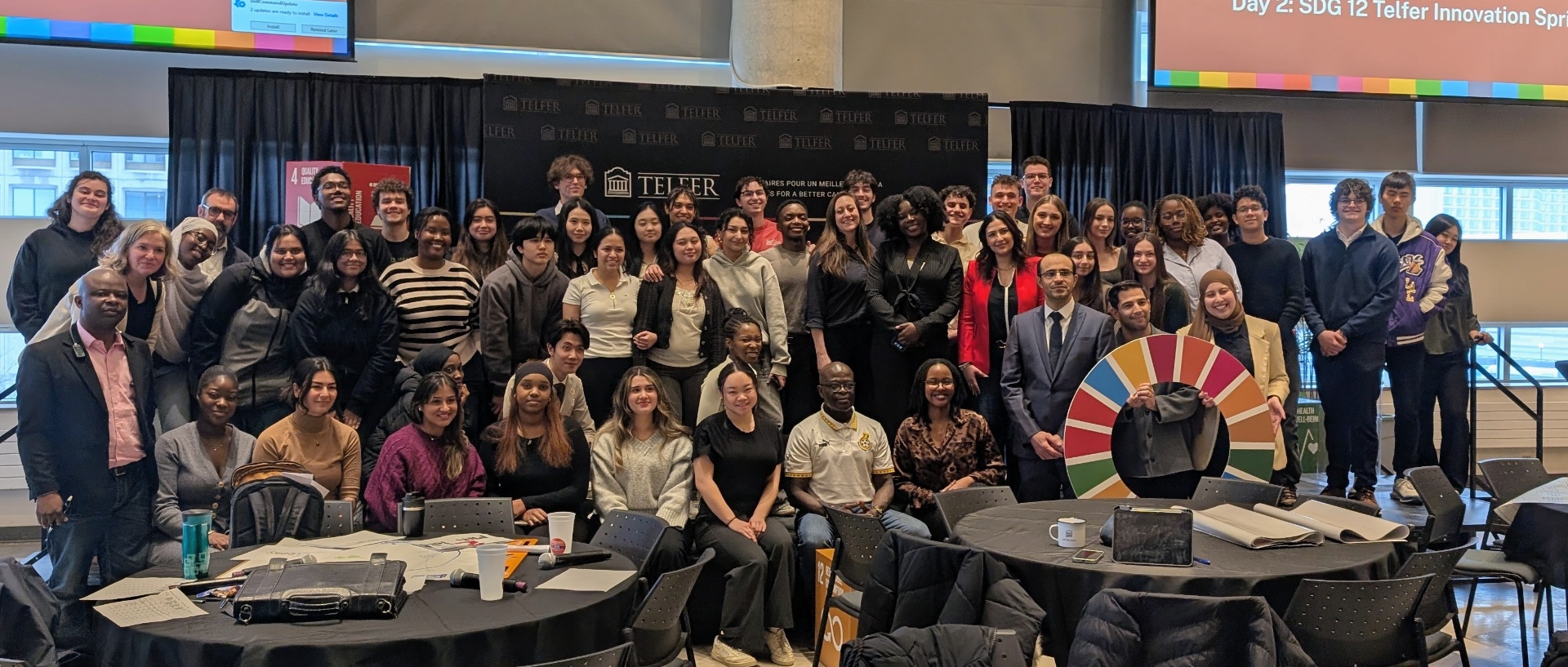
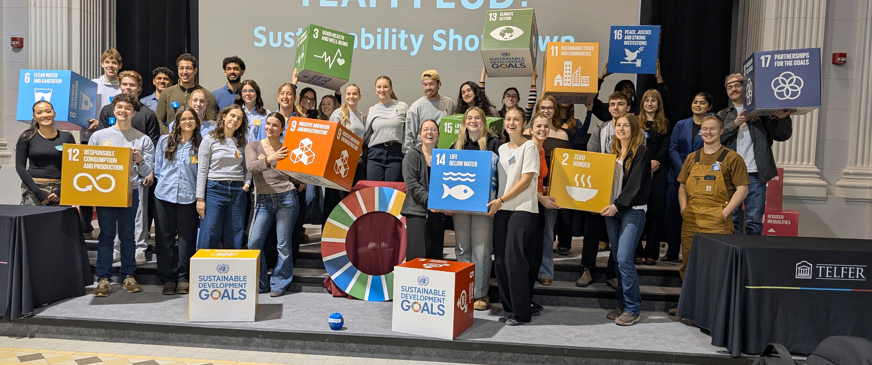
By Sunday, the students felt different. Ten interdisciplinary teams stood up, one after the other, to present what they had uncovered, challenged, and reimagined over the weekend to the judging panel, Chantal Trudel, industrial designer and interdisciplinary practitioner, Jim Delaney, systems-focused leader working at the intersection of environment and social change, and Hassan Ebrahimi, strategist, researcher, and professor at Telfer, and to each other.
Every project carried something distinct. Some focused-on materials, rethinking how products could be sourced, reused, or broken down more responsibly. Others zoomed out, looking at systems: waste streams, supply chains, and the hidden infrastructures shaping how products move through the world.
All of them were creative. All of them were thoughtful. And all of them, in their own way, revealed just how complex it is to design differently, and yet, managed in a short time to come up with thought provoking and valuable insights and imaginative ideas.
Each team had a short time to present their work and respond to the judge’s thoughtful, and often challenging, questions, pushing them to clarify their thinking, defend their choices, and consider the broader implications of their designs. But two projects stood out for their clarity, depth, and potential to move beyond the classroom.

The Innovation Development Grant ($1,500) was awarded by the judging panel to the team behind Another Step, a community-based solution rethinking footwear not as a disposable product, but as a service and skill. They did something few dared to do: they moved beyond the object and into behavior and systems, shifting the focus from redesigning products to rethinking how and why we use them in the first place. Because sometimes, the most radical intervention is not redesigning the thing, but redesigning ourselves.
Their model centered on extending the life of shoes through local repair ecosystems, pop-up workshops, partnerships with cobblers, and community spaces where people could bring in worn footwear to be repaired, repurposed, or restored. But the idea went further.

It wasn’t just about fixing shoes, it was about rebuilding knowledge and connection. Teaching repair skills. Creating local employment. Preserving a declining trade. Reducing landfill waste by redesigning how people engage with a product.
Structured in phases, from pilot workshops in Ottawa to long-term repair hubs, the project demonstrated how environmental and social impact can be built together, intentionally.
For the team, the impact of the Sprint extended well beyond the weekend. As Hawa Souleyman reflected, the experience “challenged my initial assumptions” and revealed that sustainability is not just about better products, but about “rethinking all the intricate details that empower individuals, communities, and industries toward meaningful change.”
Her Teammate Sara Yao echoed this shift, describing the Sprint as “transformative,” one that not only validated their approach through the win, but also reshaped how she sees her future: “I am particularly interested in exploring responsible investing and sustainable business models… contributing to initiatives that create positive social and environmental impact.”

The People’s Choice Award ($500), was determined by the students voting for the team they thought should win, and went to Loop Denim. Their concept reimagined denim from the ground up: 100% organic cotton, natural dyes, and fully disassemblable construction, using dissolvable threads and removable hardware to allow for easy repair, refurbishment, or recycling. At the core of the idea was a digital product passport, giving consumers visibility into the lifecycle of their jeans, from production to disposal, while encouraging more responsible use and return.
The project addressed not only environmental concerns, reducing pesticide use, lowering textile waste, but also consumer awareness and company stewardship, bridging the gap between how products are made and how they are used.
For Josh Bowry from team Loop Denim, the experience was shaped as much by the people as by the outcome: “It was the people,” he reflected. “The diversity of perspectives, that’s what made this experience for me different than any other.”
That diversity became a catalyst for deeper understanding. Through hands-on work, literally taking apart a pair of jeans to uncover the systems behind them, Josh began to see sustainability beyond surface-level choices. As he shared, the Sprint “challenged my initial assumptions” and revealed the often-invisible impacts of materials, processes, and supply chains. His team, working with fewer members than expected, adapted quickly, bringing together different skill sets to build a solution that was both technical and accessible.
That sentiment was echoed by another Sprint participant Kate Zelenski, a Biomedical Science student, who reflected on the value of working across disciplines:

“Working with students from different faculties helped me understand the importance of interdisciplinary collaboration. Everyone brought different knowledge, perspectives, and ways of thinking, which strengthened our ideas. Some students focused more on technical aspects, while others contributed to the design of our product. This diversity allowed us to approach the problem from multiple angles.”
For her, the takeaway extended beyond the Sprint itself: “It showed me that complex issues like sustainability cannot be solved from a single perspective they require collaboration across different areas of knowledge.”
Take a closer look at the ideas that came out of the Sprint and the teams behind them.
The Ecosystem Behind the Experience
This Sprint was made possible by a network of collaborators, academic leaders, community partners, mentors, and organizations, who understand that sustainability is not built alone, but together.
A special mention belongs to the Office of Campus Sustainability, whose Free Store provided many of the materials students worked with throughout the weekend. Grounded in a simple but powerful idea, that nothing needs to be new to have value, the Free Store brought circularity into the room in a tangible way. And in return, teams were encouraged to give back, reinforcing the very systems they were being asked to rethink.
Sustainability was also embedded in how the Sprint itself was run. Through a partnership with Friendlier, participants used reusable containers, cups, and dishware throughout the weekend, reducing waste while experiencing firsthand what a circular system can look like in practice.
The experience was further shaped by the insight and engagement of a wide range of partners and contributors, including the Circular Innovation Council, WSP, EcoEquitable, Export Development Canada (EDC), Food Cycle Science (FoodCycler), CAFES Ottawa, Eco Safe Sense, The Upcycling Club, Nu Grocery, and Amano Gardens, as well as collaborators connected through Community Service Learning (CSL) at the University of Ottawa, and generously supported in part by BHER.
Each brought a different lens, policy, design, engineering, circular economy, community impact, and lived experience, ensuring that the conversations and solutions developed over the weekend were not only innovative, but grounded in real-world complexity.

And perhaps that is what stayed with me most: behind every idea, every prototype, every conversation was a collective effort to build something better, together.
Being in that space made it impossible not to reflect on what was happening beyond it. Undoubtedly, we are living through a moment of deep uncertainty, one where tensions are rising, where the possibility of large-scale conflict no longer feels distant, and where many of the social and environmental advances of the past decades feel increasingly fragile.
And yet, in the midst of that, while the world outside felt unsettled, inside this Sprint, I felt very fortunate to have gotten a front row seat to see students from different backgrounds, disciplines, and lived experiences come together, not to debate what is wrong with the world, but to actively design what could be better.
I saw curiosity over cynicism. Collaboration over division. Action over paralysis. For a moment, we were not reacting to the world. We were shaping it. And perhaps that is the quiet power of spaces like this. Not that they solve everything.
But that they remind us, clearly, undeniably, that another way is still possible.
Looking Ahead
The Innovation Sprint may have ended on that Sunday afternoon but for some teams, it continues through self-directed courses. For others, it will live on in how they think, design, and decide. Because the real outcome of this Sprint is not the prototypes. It is the shift. A shift toward seeing systems instead of objects. Toward designing with people, not just for them.
And that no matter how complex the world becomes, we still have a choice: to participate in the systems that exist, or to build the ones that should.


This article was written by Takwa Youssef, coordinator of Telfer's Green Academy.
As coordinator of the Green Academy, Takwa plays a key role in supporting the delivery of the academy's interdisciplinary programs. She oversees logistics, event coordination, and resource management, ensuring the successful execution of courses, workshops, training, and research. Takwa bridges faculties, services, and external partners, cultivating collaboration that enriches the program’s impact. She manages communication, finances and administration, while also driving the Academy’s long-term vision by strengthening connections across disciplines and supporting its ongoing growth.

.jpg)