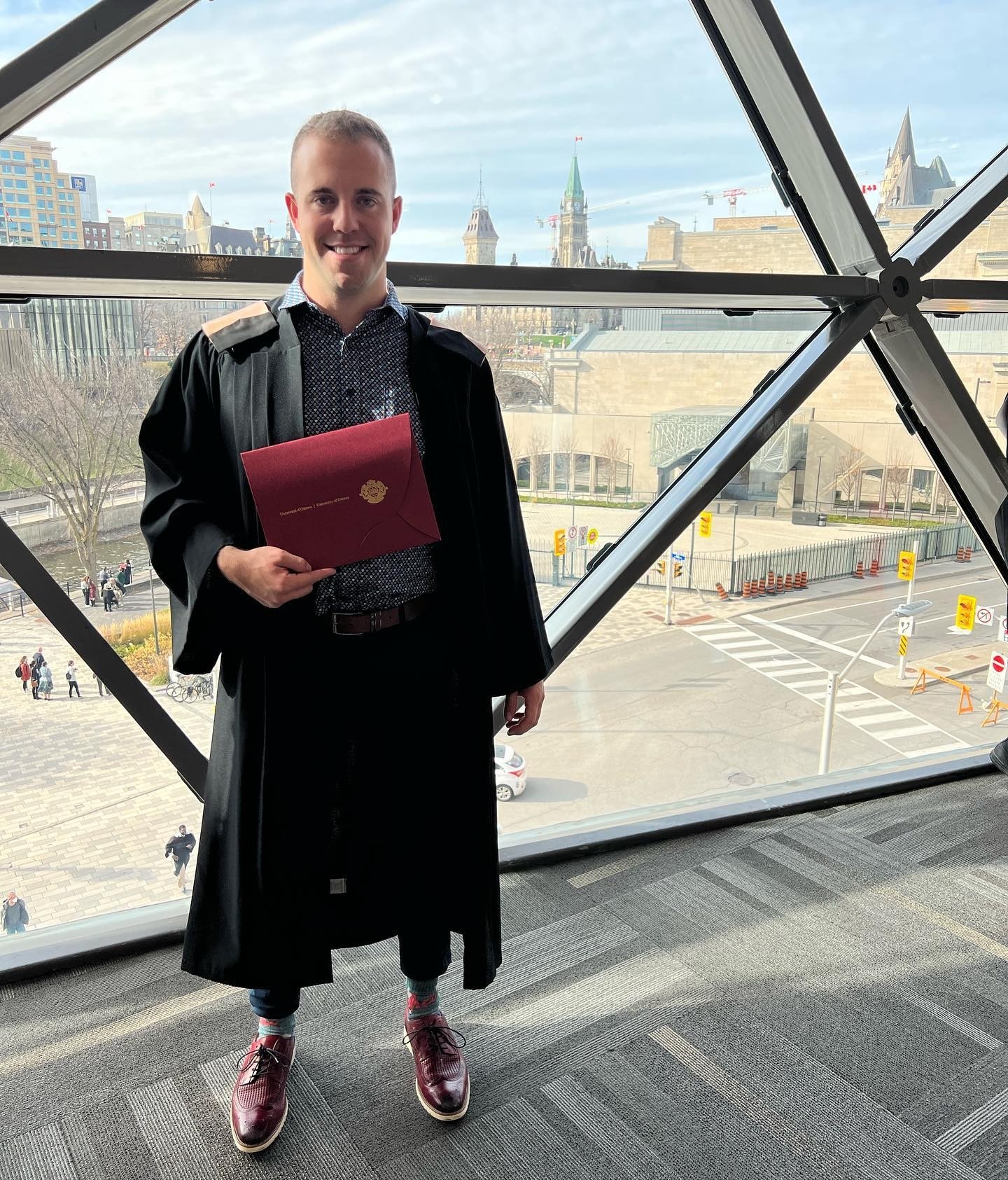
Raphaël Gagné graduated from the Telfer School of Management in 2020. Now, he’s the founder of Wisera Technologie. During his time at Telfer, he was also a Gee-Gees athlete. From balancing academics and athletics to building a technology-driven company, his story reflects the importance of adaptability, structure and continuous learning.
This article explores his journey at Telfer and how this experience shaped his path, helping him build his own company. It also highlights his insights and advice for current Telfer students interested in pursuing entrepreneurship.
1. Can you tell us about your journey at uOttawa? How did your experience as both a Telfer student and a Gee-Gees athlete influence your path toward founding Wisera Technologie? What made you decide to pursue entrepreneurship?

I started my journey at Telfer in 2016. At the time, I already had an entrepreneurial mindset, managing a few small businesses while also being a student-athlete. One of the biggest opportunities that I found was at the MakerLab in the STEM Complex. With access to free 3D printers, I could bring my ideas to life.
I knew from the start that I wanted to go into marketing because I wanted to build my own business. As a football player balancing school and training, I became obsessed with time management and organization to stay well structured. That’s when I realized how valuable it would be to have one platform to centralize everything, from contacts and deadlines to work and personal projects. While searching for a solution, I discovered Monday.com and started using it to track and optimize my time. Then, I started adding features by asking people, and this is where Wisera started.
It initially started as a marketing agency focused on logos, brand identity and advertising. Over time, the company evolved rapidly. Now at Wisera, we’re developing a custom project management platform and customer relationship management system for businesses. Five years later, we’re now supporting nearly 100 clients across industries such as cities, marketing agencies, construction, real estate and sports management.
2. During your time in Telfer, were there any courses, professors or experiences that changed the way you think about solving problems or making decisions as a founder?
The courses ADM 3316 — Competitive Intelligence and ADM 3321 — Consumer Behaviour really inspired me. In Consumer Behaviour, I learned the importance of listening and using strategic approaches to guide people in a conversation, which showed me how powerful emotional intelligence really is. In both of these courses, I learned early on that you have to invest in networking and focus on the physical and skills aspects of speaking to get close to people.
I believe that having strong emotional intelligence and good listening comprehension could really help you grow your network. Strong emotional intelligence and active listening helped me build relationships across every stage of my journey, from football to business. These connections will open doors or support you, because you never know who could help you at any time.
Among the techniques I learned from both courses, “nose to toes” is one that has stayed with me and that I still use today. This technique involves quickly observing visual cues to better understand someone and start a meaningful conversation.
3. What first inspired the idea behind Wisera Technologies? How did your business education help you get started with building the company?

The idea is to bring vision to value. A lot of the people around me either didn’t understand technology or didn’t know how to set things up, so I wanted to find a faster way to turn what they had in mind into something real. I realized that most of the challenge comes down to operations and execution, and the fact that information is often not centralized. When systems don’t communicate, it becomes hard to move forward. I wanted to find a way to centralize and connect the dots to build application programming interfaces (APIs), run analysis and leverage that data effectively.
My initial idea started because I wanted to help other people, and over time, it evolved into something bigger. We started focusing on helping CEOs and business owners turn their ideas into structured, operational systems. Most businesses don’t lack data — they lack connectivity between their data.
When someone wants to work with us, we collect key information such as their contact details, company data and how they found us, and use it to qualify leads through our customer relationship management system and key performance indicators. Once they become clients, we manage the relationship through dashboards and logbooks, tracking performance metrics such as leads generated and hours worked. From there, we centralize everything into Monday, integrate systems, provide training and continue with ongoing updates. We’re now also building AI agents and running Monday-based campaigns to further optimize operations.
4. Can you share a challenge or setback you faced early in your entrepreneurial journey? How did your time at uOttawa help you push through it and adapt?
Gee-Gees showed me that, as an entrepreneur, you want everything to move fast and expect things to happen immediately. But at Telfer, I had to learn patience because I couldn’t get into marketing right away and had to wait a few terms, even though I wanted it now. Through both experiences, I realized that just because you want something now doesn’t mean it’s the right time for you. Some things take longer, so be patient. Sometimes, you don’t have to rush it — you can come back to it and just let it flow.
I also learned that delays aren’t always a reflection of your value or effort. Sometimes, it’s just timing, and you have to accept that.
5. For current Telfer students who are interested in entrepreneurship, what’s one mindset or habit they should start developing now? If you could go back to your time at university, what’s one piece of advice you would give to yourself?
In a world where technology is evolving really fast, you need to be intentional about how you consume information, because we’re living in an era of overload. It’s important to focus on the right sources, get closer to the industry you’re interested in and actively connect with people who are already working in it.
Today, the people who can deliver value the fastest are the ones who succeed. You need to develop the ability to adapt and understand how systems work. I think it works like a team, how a volleyball team and a football team operate differently. You don’t need to know every small detail, but you need to understand the logic behind how they’re structured. If you can build something and understand the infrastructure, you can apply it to different situations, because no case is ever exactly the same.
This mindset is something you can develop over time. I didn’t have it at the beginning, but I learned how to think more logically, how to break things down and how to build systems. In the end, even in fields like marketing that are seen as creative, structure and logic are essential. Otherwise, everything becomes scattered and hard to manage.